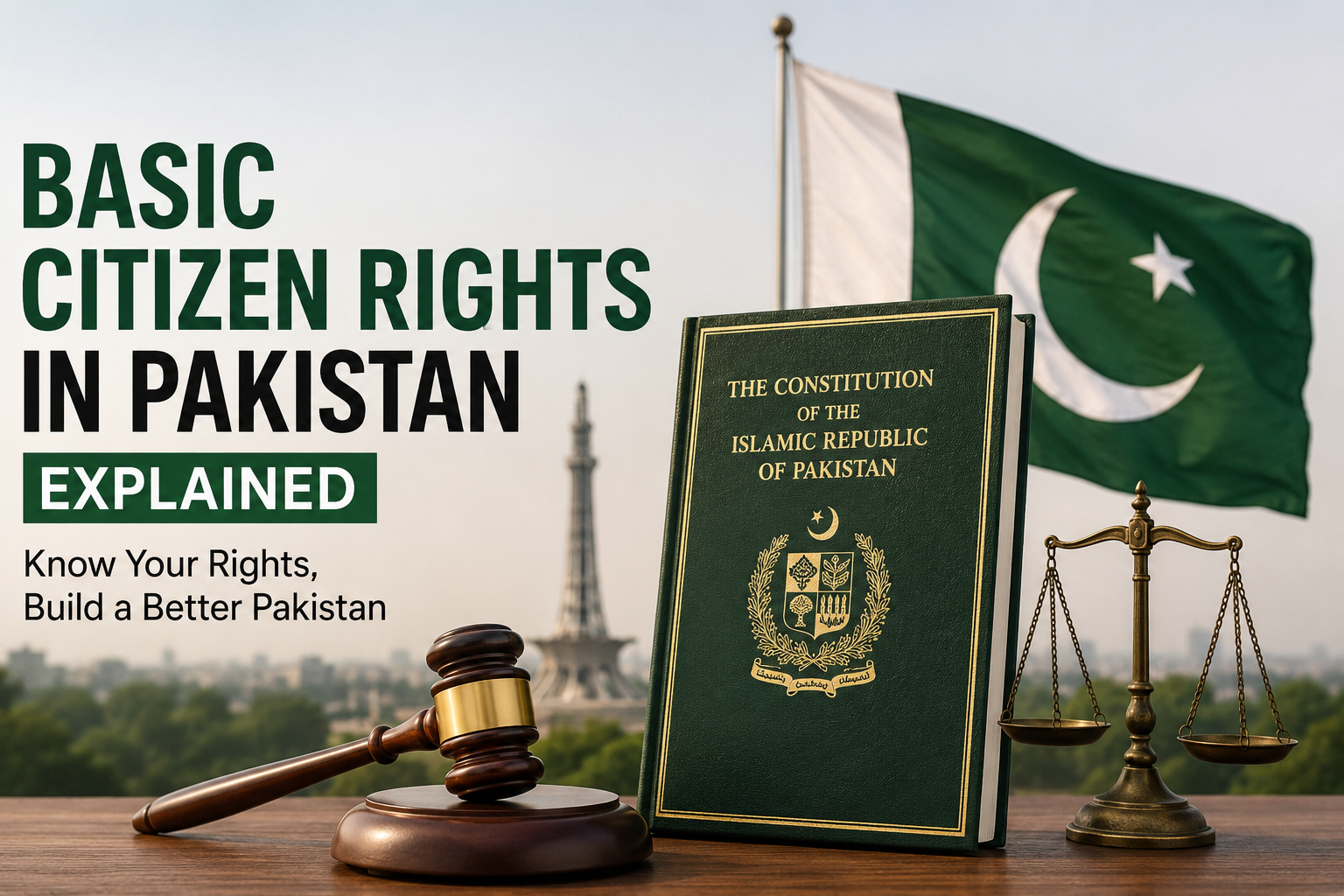
Understanding basic citizen rights in Pakistan is important for every person who wants to live with dignity, freedom, and security. In my view, knowing our rights is not only useful when we face a problem. It also helps us understand our responsibilities and our relationship with the state.
The Constitution of Pakistan provides several fundamental rights to citizens. These rights cover important areas such as equality, personal freedom, education, religion, expression, movement, and access to justice. However, like rights in any country, these freedoms are subject to certain legal conditions and limitations.
In this article, I will explain the basic citizen rights in Pakistan in simple language so that an ordinary reader can understand what these rights mean in everyday life.
What Are Citizen Rights in Pakistan?
Citizen rights are protections and freedoms given to people under the Constitution and laws of Pakistan. The Constitution of the Islamic Republic of Pakistan contains a section on fundamental rights, particularly in Articles 8 to 28.
I believe the most important thing to understand is that these rights are not simply ideas. They provide a legal foundation for protecting individuals from unfair treatment and unlawful actions.
At the same time, citizens also have responsibilities. Respecting the law, respecting other people’s rights, and contributing positively to society are important parts of being a responsible citizen.
Right to Equality
One of the most important basic citizen rights in Pakistan is equality before the law. Article 25 of the Constitution states that all citizens are equal before law and are entitled to equal protection of law.
This means a person’s legal rights should not depend simply on wealth, social position, or family background. In principle, every citizen should receive equal protection under the law.
The Constitution also recognizes that special provisions can be made for the protection of women and children. This shows that equality does not always mean treating every person in exactly the same way. Sometimes additional legal protection is necessary to create fairness.
In my opinion, equality is one of the foundations of a healthy society because people need to believe that the law protects them fairly.
Right to Life and Personal Liberty
The right to life and personal liberty is another major constitutional protection. Article 9 provides that no person shall be deprived of life or liberty except in accordance with law.
This right is extremely important because personal freedom is connected with almost every part of daily life. A person should not be unlawfully detained, restricted, or deprived of liberty.
The law does allow authorities to take action in situations permitted by law. However, such action must have a legal basis.
For ordinary citizens, understanding this right can help them recognize why lawful procedures are important when dealing with arrests, detention, and criminal investigations.
Freedom of Movement
Citizens of Pakistan generally have the right to move freely throughout the country and to reside and settle in any part of Pakistan, subject to reasonable restrictions imposed by law in the public interest.
This is especially important for people who travel for education, employment, business, or family reasons.
For example, a citizen may choose to move from one province or city to another for a job or education. The constitutional right to movement supports this freedom while recognizing that the law can impose reasonable restrictions in certain circumstances.
Freedom of Speech and Expression
Freedom of speech and expression is an important citizen right in Pakistan. Article 19 provides this freedom subject to restrictions imposed by law.
In simple terms, citizens generally have the right to express their opinions and communicate their views. This can include discussing public issues, writing articles, participating in debates, and expressing opinions about social matters.
However, freedom of speech does not mean that everything can legally be said without consequences. The Constitution itself recognizes restrictions relating to matters such as the glory of Islam, national security, public order, decency, morality, and other areas specified by law.
In my view, responsible speech is just as important as freedom of speech. We should use our freedom without deliberately harming others or spreading false information.
Freedom of Religion
Pakistan’s Constitution provides important protections relating to religion. Article 20 gives every citizen the right to profess, practice, and propagate his religion, subject to law, public order, and morality.
The Constitution also provides protections for religious communities.
Religious freedom is an important part of a person’s identity and personal life. Citizens should understand both their own rights and the importance of respecting the religious rights of other people.
A peaceful society requires people to understand that constitutional rights come with respect for the rights of others.
Right to Education
Education is another important constitutional right. Article 25A provides that the state shall provide free and compulsory education to all children between the ages of five and sixteen years in the manner determined by law.
I consider education one of the most powerful rights because it can influence almost every other area of life. A person with access to education has better opportunities to understand laws, find employment, make informed decisions, and participate in society.
Education also helps citizens understand their constitutional rights and responsibilities.
Protection of Property Rights
The Constitution also protects property rights. Article 23 provides that every citizen has the right to acquire, hold, and dispose of property in any part of Pakistan, subject to the Constitution and reasonable restrictions imposed by law.
Article 24 provides further protection relating to property.
Property rights are particularly important for families, business owners, farmers, and people who invest their savings in homes or other assets.
At the same time, property ownership is regulated by law. Citizens should therefore maintain proper documents and follow legal procedures when buying, selling, transferring, or inheriting property.
Right to Privacy
The privacy of home is protected under Article 14 of the Constitution, subject to law.
Privacy is increasingly important in modern society because people now use phones, computers, online banking, and social media every day.
Although constitutional privacy protections are important, citizens should also take personal steps to protect their information. Strong passwords, secure accounts, careful use of social media, and awareness of online scams can help reduce privacy risks.
Right to Assembly and Association
Citizens have constitutional rights relating to peaceful assembly and association, subject to reasonable restrictions imposed by law.
This means people can participate in lawful gatherings and form or join associations within the limits established by law.
These rights are important because communities often work together to discuss problems, support causes, create organizations, and participate in public life.
However, peaceful participation is essential. Rights should not be used as an excuse for violence or unlawful activity.
Right to Form or Join Political Parties
Political participation is an important part of a democratic system. Citizens have rights relating to forming or joining political parties, subject to constitutional and legal requirements.
Political parties provide a way for people to organize around ideas, policies, and public concerns.
From my point of view, citizens should not only know that they have political rights. They should also learn about candidates, policies, and issues before making political decisions.
An informed citizen can contribute more effectively to democracy.
Protection Against Unlawful Arrest and Detention
The Constitution provides protections for people who are arrested or detained. Article 10 contains safeguards concerning arrest and detention.
These protections are important because the power of the state must operate according to law.
A person who is arrested should understand that criminal law has procedures that authorities are expected to follow. Depending on the circumstances, legal representation and access to the courts can also become important.
Anyone facing a serious legal problem should seek advice from a qualified lawyer rather than relying only on general information found online.
Right to a Fair Trial
Article 10A of the Constitution provides the right to a fair trial and due process for the determination of civil rights and obligations or in criminal charges.
This is one of the rights I consider essential for justice. A fair legal system should provide procedures through which allegations can be examined and decisions can be made according to law.
A fair trial also protects society because justice should not be based simply on accusations or personal influence.
Protection Against Discrimination
The Constitution contains protections against discrimination in important areas. Article 25 establishes equality of citizens before law, while other constitutional provisions address discrimination and equal opportunity in specific circumstances.
Citizens should understand that discrimination can be a complex legal issue. Whether a particular action is unlawful depends on the facts and the applicable law.
The broader principle is clear: people should be treated with dignity and fairness.
Right to Information
The Constitution also recognizes the right of citizens to have access to information in matters of public importance, subject to regulation and reasonable restrictions imposed by law.
Access to information can help citizens understand government decisions, public policies, and matters affecting society.
In my opinion, informed citizens are more capable of asking meaningful questions and participating responsibly in public affairs.
Rights Come With Responsibilities
While discussing basic citizen rights in Pakistan, I believe it is equally important to discuss responsibilities.
A citizen should respect the Constitution and law, respect other people’s rights, protect public property, pay legally required taxes, and contribute positively to the community.
Freedom should not be understood as permission to harm another person. For example, freedom of expression should be exercised responsibly, and freedom of assembly should remain peaceful.
Rights and responsibilities work together. A society becomes stronger when citizens understand both.
Why Should Every Pakistani Know Their Rights?
Many people only think about their legal rights after experiencing a problem. I believe this approach should change.
Knowing basic citizen rights can help people communicate with government departments, understand legal procedures, recognize unfair treatment, and seek appropriate help when necessary.
It can also reduce fear and confusion. When people understand the Constitution and the law, they can make better decisions.
Students, workers, business owners, parents, and young people can all benefit from learning about their rights.
Final Thoughts
Basic citizen rights in Pakistan are an important part of the country’s constitutional system. Rights such as equality, personal liberty, freedom of movement, freedom of expression, religious freedom, education, property protection, privacy, peaceful assembly, political participation, and fair trial provide important protections for citizens.
In my view, knowing these rights is the first step toward becoming a more responsible and confident citizen. But rights should always be understood together with the law and the rights of other people.
The Constitution provides the foundation, while courts and laws help determine how these rights work in specific situations. If a person faces a serious legal issue, professional legal advice is always better than relying on a general online article.
A better society begins when ordinary people understand the law, respect one another, and know how to use their rights responsibly. That is why learning about basic citizen rights in Pakistan is not only useful for individuals. It is also important for the future of the country.
SEO Keywords: basic citizen rights in Pakistan, citizen rights in Pakistan, fundamental rights in Pakistan, constitutional rights in Pakistan, rights of Pakistani citizens, Constitution of Pakistan, freedom of speech in Pakistan, right to education in Pakistan, right to equality in Pakistan, legal rights of citizens in Pakistan