When we talk about laws in Pakistan, many people only think about courts, lawyers, police, or government offices. In my view, understanding how laws are actually made is equally important because laws affect almost every part of our daily lives. From education and taxation to business, criminal justice, property, employment, and public services, many decisions are ultimately connected with legislation.
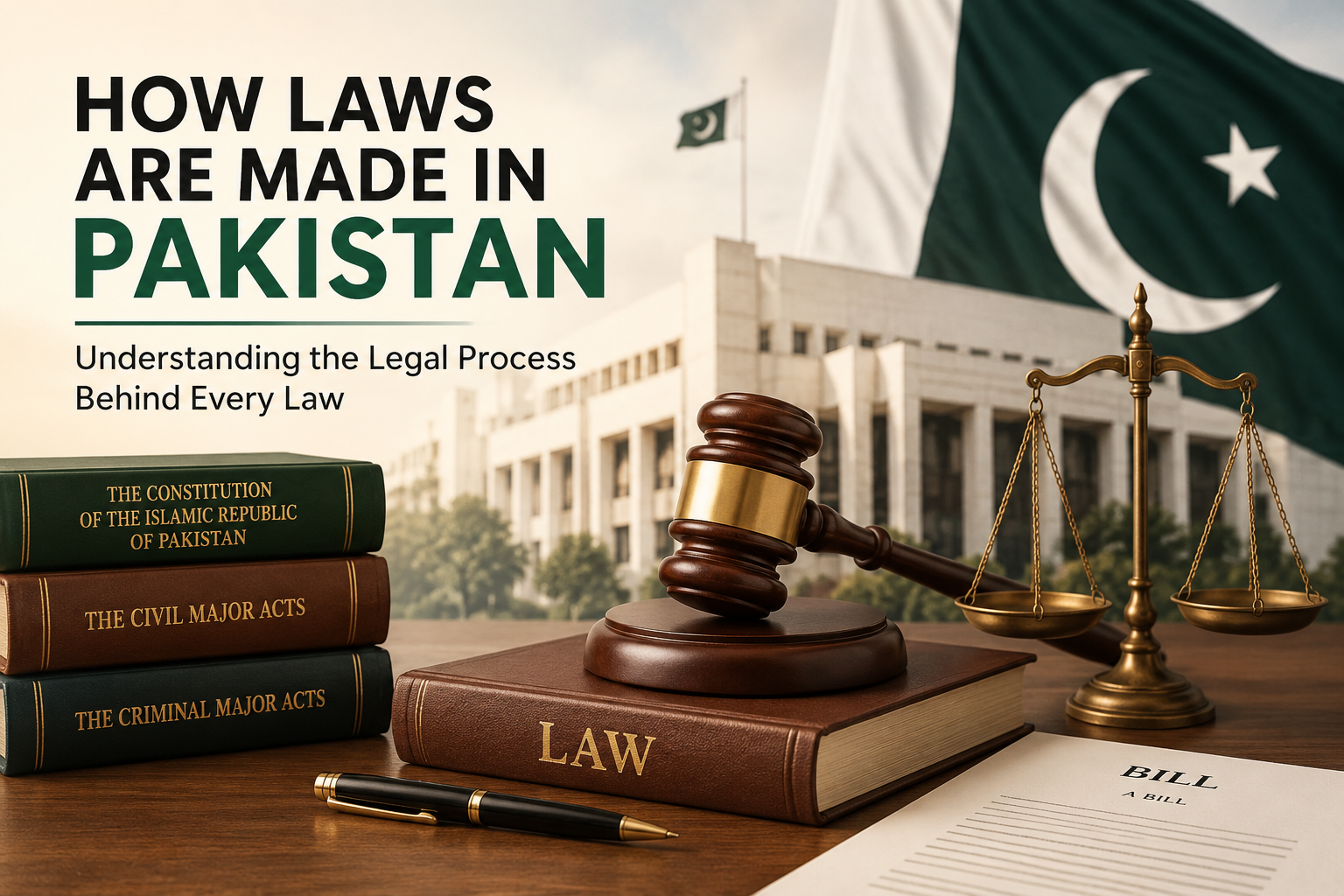
The law making process in Pakistan follows a constitutional and parliamentary procedure. At the federal level, Parliament consists of the President, the National Assembly, and the Senate. A proposed law generally begins its journey as a bill and must pass through several stages before it becomes an Act of Parliament.
In this article, I will explain how laws are made in Pakistan in simple language, including the role of Parliament, the National Assembly, the Senate, parliamentary committees, voting, and presidential assent.
What Is a Bill?
Before understanding the law making process in Pakistan, it is important to understand what a bill means.
A bill is a formal proposal for creating a new law or changing an existing law. A bill is not automatically a law. It has to go through the required parliamentary process before it can become an Act of Parliament.
According to the National Assembly, legislation can begin through a government bill or a private member’s bill. Money bills have a special procedure and originate in the National Assembly.
For example, if the government believes that an existing law needs to be changed because of new circumstances, it may prepare an amendment bill. Similarly, a member of Parliament may introduce a proposal dealing with a particular public issue.
Who Makes Laws in Pakistan?
At the federal level, Parliament plays the central role in making laws. Pakistan has a bicameral Parliament, meaning it has two Houses: the National Assembly and the Senate.
The National Assembly represents the people through elected members from constituencies across Pakistan. The Senate provides representation to the provinces and other areas according to the constitutional system.
Both Houses have important roles in the legislative process. However, money bills have a special constitutional procedure and are dealt with primarily through the National Assembly.
I think this two House system is important because legislation can receive consideration from representatives serving different constitutional roles.
Step 1: Identifying the Need for a Law
Every law usually starts with a problem, policy objective, or public need.
For example, a government department may identify a problem that is not adequately covered by existing legislation. Members of Parliament may also identify an issue through discussions with citizens, organizations, experts, or their own political and legislative work.
The government may then decide that new legislation is required. In other cases, a Member of Parliament can introduce a private member’s bill.
At this stage, the basic idea is developed into a formal legislative proposal.
Step 2: Preparing the Bill
Once the need for legislation has been identified, the proposal is converted into the form of a bill.
The bill normally explains what the proposed law intends to achieve and contains provisions that would establish new rules or amend existing legislation.
This stage is extremely important because unclear wording can create difficulties later. A law needs to be written carefully so that courts, government institutions, businesses, and ordinary citizens can understand how its provisions are supposed to operate.
Step 3: Introduction in Parliament
The next important stage is the introduction of the bill in Parliament.
For matters falling within the federal legislative sphere, a bill may originate in either House subject to constitutional rules. The National Assembly explains that once a bill is introduced, it proceeds through readings, examination, debate, and voting.
The introduction of a bill does not mean that the proposed law has been approved. It simply begins the formal parliamentary process.
This distinction is important because people sometimes hear that Parliament has introduced a bill and assume that the bill has already become law. That is not necessarily the case.
Step 4: First Reading
The first reading is associated with the introduction of the bill.
At this point, Parliament formally receives the proposed legislation and begins considering it under parliamentary procedure.
The bill then moves toward more detailed examination.
The National Assembly describes the legislative process as involving first reading, detailed review and committee examination, followed by further debate and a final vote.
Step 5: Committee Examination
One of the most important parts of the law making process in Pakistan is the role of parliamentary committees.
A bill may be referred to the relevant standing committee for detailed consideration. Committees can examine the proposed legislation more closely and consider its different provisions.
This stage can involve detailed discussion, recommendations, and suggestions. Parliamentary committee work allows members to study legislation beyond the general debate that takes place in the House.
The National Assembly’s procedural material explains that committees examine bills and submit reports containing suggestions and recommendations.
In my view, committee examination is one of the most valuable stages because complicated legislation often requires more detailed attention than can be given during a general parliamentary sitting.
Step 6: Debate and Amendments
After examination, members can debate the bill.
Members supporting the proposal may explain why they believe the legislation is necessary. Members who have concerns may identify problems, weaknesses, or possible consequences.
Amendments may also be proposed where parliamentary procedure allows them.
This is where different political views can become part of the legislative process. A bill may change during its journey because members suggest modifications to its wording or provisions.
The purpose of debate is not simply to approve or reject a proposal. It also gives Parliament an opportunity to examine how the proposed law may affect the country.
Step 7: Voting in the First House
After the required stages of consideration, the House votes on the bill.
If the required majority is achieved, the bill moves forward.
For ordinary federal legislation, the bill generally needs to pass through both Houses according to the constitutional procedure. The National Assembly explains that after approval by the originating House, a bill proceeds to the other House for consideration.
If the second House passes it without disagreement, the bill can proceed toward presidential assent.
Step 8: Consideration by the Other House
The second House examines the bill according to parliamentary procedure.
For example, a bill originating in the National Assembly may move to the Senate when the Constitution requires Senate consideration. The Senate then considers the proposal and may pass it or deal with it according to the applicable constitutional procedure.
If both Houses agree on the final legislation, the bill moves toward the next stage.
However, if the Houses disagree, the Constitution provides mechanisms for resolving the disagreement, including a joint sitting in specified circumstances.
Step 9: Special Procedure for Money Bills
Money bills have a different constitutional route.
The National Assembly has the primary role in financial legislation, and the Senate has a specific constitutional role in relation to money bills rather than the same legislative position it has for ordinary bills.
This special procedure exists because taxation, public expenditure, and government finances are closely connected with the elected National Assembly.
For anyone researching how laws are made in Pakistan, understanding the difference between ordinary bills and money bills is therefore important.
Step 10: Presidential Assent
After a bill has successfully completed the required parliamentary process, it is presented to the President for assent.
Presidential assent is an important constitutional stage. The Senate’s official legislation information explains that when both Houses agree on the final content of a bill, it proceeds for presidential assent and becomes an Act of Parliament.
The current parliamentary information states that the President is required to deal with a bill within the constitutionally specified period. If a bill is returned for reconsideration where permitted, Parliament considers it again through the prescribed procedure.
Once the constitutional requirements are completed, the bill becomes law and is known as an Act of Parliament.
Step 11: Publication and Implementation
After a bill becomes an Act, it becomes part of Pakistan’s body of federal legislation.
The Pakistan Code provides a searchable collection of federal laws and Acts, which helps citizens, lawyers, students, researchers, and professionals find legislation.
However, making a law is only one part of the process. The government and relevant institutions must also implement it.
Sometimes legislation requires rules, regulations, notifications, or administrative arrangements before its provisions can operate effectively.
This is why I believe that the success of a law should not only be judged by its passage in Parliament. Its practical implementation also matters.
What Happens When the Houses Disagree?
Disagreement between the National Assembly and Senate does not necessarily mean that the legislative process ends.
The Constitution provides procedures for dealing with disagreements, including a joint sitting in relevant circumstances. During a joint sitting, members of both Houses participate in consideration of the bill.
If the bill is approved through the constitutionally required process, it can then proceed toward presidential assent.
This mechanism helps Parliament resolve legislative disagreements rather than allowing one disagreement between the Houses to permanently prevent consideration of a proposal.
How Are Constitutional Amendments Made?
A constitutional amendment is different from an ordinary law.
The Constitution provides a special procedure and requires stronger parliamentary support. For example, Article 239 provides requirements involving the National Assembly and Senate, including a two thirds majority of the total membership in specified stages.
This higher threshold reflects the importance of the Constitution. Ordinary legislation can generally be changed through the ordinary legislative process, while constitutional amendments require the special procedure established by the Constitution.
Can a Law Be Challenged in Court?
Yes, legislation can become the subject of judicial review.
The courts have an important role in interpreting laws and examining legal questions within their constitutional jurisdiction.
This means the law making process does not exist separately from the judicial system. Parliament makes legislation within its constitutional authority, while courts interpret and apply laws and may consider constitutional questions according to their jurisdiction.
For ordinary citizens, this is an important part of understanding the legal system because passing a law is not necessarily the end of every legal dispute concerning that law.
Why Should Ordinary Citizens Understand the Law Making Process?
In my opinion, understanding how laws are made in Pakistan makes citizens more aware of how government works.
When a new bill is discussed in the news, people can better understand the difference between a proposal and an actual law. They can also understand why parliamentary debates, committee meetings, voting, and presidential assent matter.
It also helps students, journalists, business owners, employees, and ordinary citizens understand where laws come from.
A citizen does not need to be a lawyer to understand the basic legislative process. Knowing that a bill must pass through defined constitutional and parliamentary stages makes political and legal news much easier to follow.
Final Thoughts
The law making process in Pakistan is a structured constitutional process rather than a simple decision made by one person or one institution. A proposed idea can become a bill, move through parliamentary stages, receive detailed examination, face debate and voting, pass through the required Houses, and ultimately proceed for presidential assent.
The National Assembly and Senate both have important roles, while parliamentary committees provide detailed examination of legislation. Money bills and constitutional amendments follow special procedures because of their constitutional importance.
From my point of view, learning how laws are made in Pakistan is useful for everyone. Laws influence our rights, responsibilities, businesses, families, education, taxes, and everyday activities. The better we understand the process behind legislation, the better we can understand the country in which we live.
This article is intended for general educational and informational purposes and should not be treated as legal advice. Constitutional and legislative procedures can change, so readers should consult the latest official legal sources for specific legal questions.
Suggested SEO Keywords
how laws are made in Pakistan, law making process in Pakistan, how a bill becomes law in Pakistan, Parliament of Pakistan, National Assembly law making process, Senate of Pakistan legislation, legislative process in Pakistan, bill to Act in Pakistan, Pakistani law making procedure, how Parliament makes laws in Pakistan