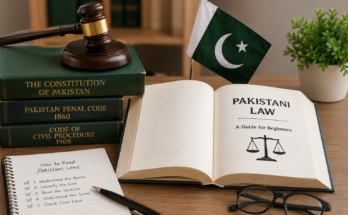
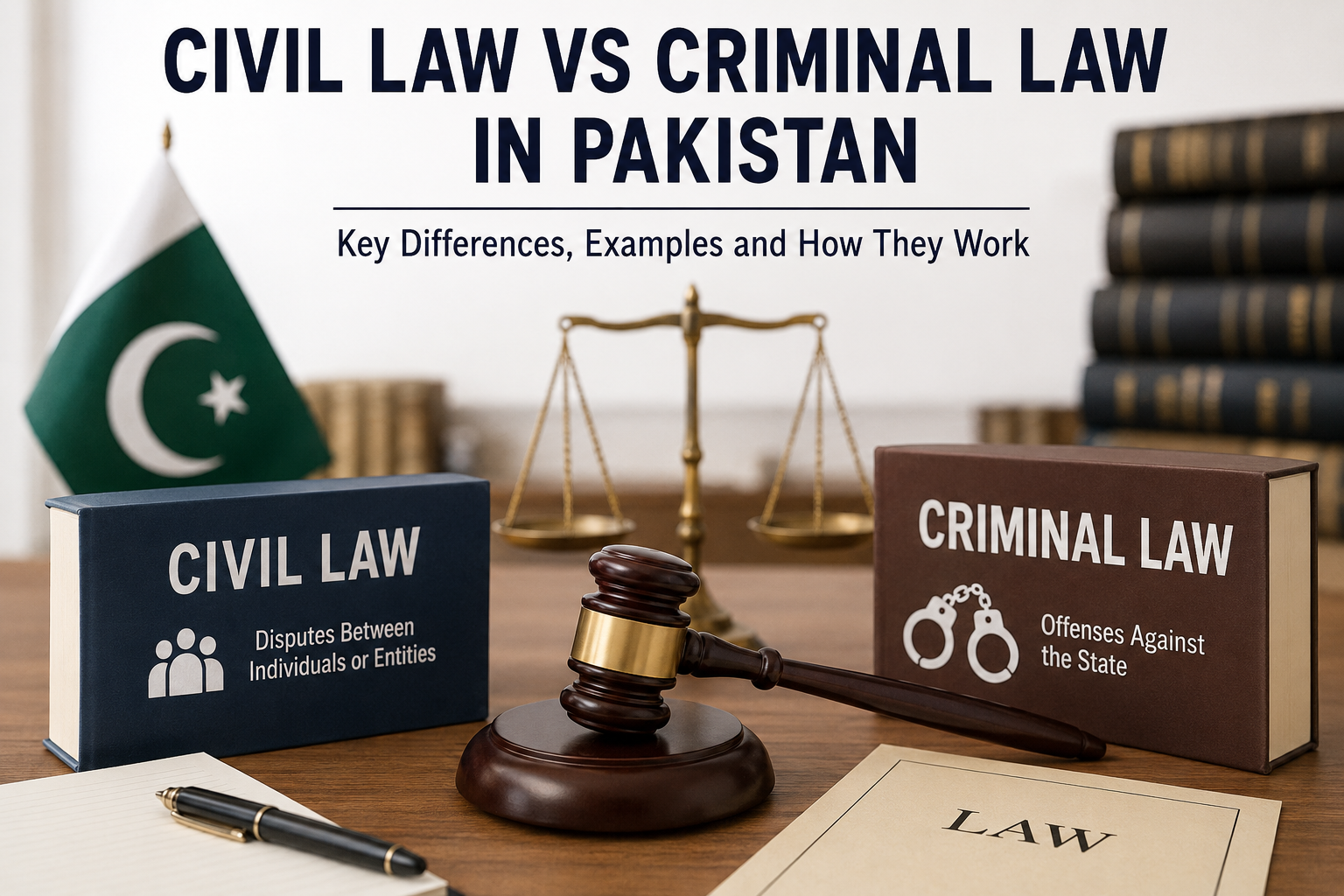
When people hear the word law, they often think about police, courts, lawyers, and criminal cases. However, Pakistani law covers many different types of disputes, and two of the most important areas are civil law and criminal law. Understanding the difference between civil law and criminal law in Pakistan can help ordinary people understand what may happen when a dispute or alleged offence reaches the courts.
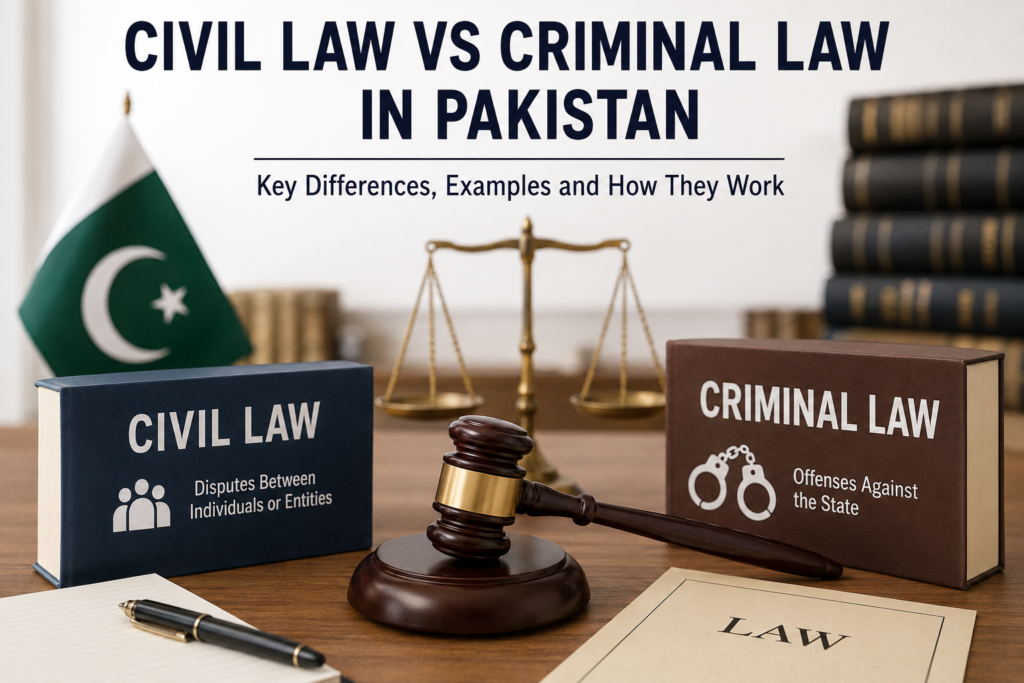
In my view, the easiest way to understand the difference is to look at the purpose of each type of case. Civil law generally deals with disputes involving rights, property, money, contracts, family matters, and other private interests. Criminal law, on the other hand, deals with acts that are considered offences against the law and may result in punishment by the state.
The Pakistan Code maintained by the Ministry of Law and Justice separately lists civil laws and criminal laws and provides access to important legislation, including the Code of Civil Procedure and the Code of Criminal Procedure.
What Is Civil Law in Pakistan?
Civil law in Pakistan generally deals with disputes between individuals, organizations, companies, or other parties concerning legal rights and obligations. A civil case may arise when one person believes that another person has violated a legal right or failed to fulfill an obligation.
Common examples include property disputes, contract disputes, recovery of money, ownership matters, certain family disputes, inheritance related claims, and disputes involving other private rights.
The Code of Civil Procedure, 1908, commonly known as the CPC, provides an important procedural framework for civil litigation. The Pakistan Code identifies the CPC as one of Pakistan’s federal laws.
For example, imagine that someone purchases property and later discovers that another person is claiming ownership of the same property. The disagreement may become a civil dispute because the central issue is determining the legal rights of the parties.
The purpose of a civil case is normally not to send someone to prison. Instead, the court may provide a legal remedy depending on the facts and applicable law. Such remedies can include compensation, recovery of money, declaration of rights, injunctions, possession, or other relief recognized by law.
What Is Criminal Law in Pakistan?
Criminal law deals with conduct that the law recognizes as an offence. In a criminal matter, the state becomes involved because an alleged offence is considered a matter of public concern.
Examples can include theft, robbery, assault, murder, cheating, criminal breach of trust, and other offences defined under Pakistani law.
The Pakistan Penal Code, 1860 is one of the major statutes dealing with criminal offences in Pakistan. The Code of Criminal Procedure, 1898 provides important rules concerning investigation, inquiry, trial, and other criminal proceedings. The official Pakistan Code states that offences under the Pakistan Penal Code are investigated, inquired into, tried, and otherwise dealt with according to the relevant criminal procedure.
Criminal courts in Pakistan include Courts of Session and Magistrates, along with the jurisdiction of higher courts as provided by law.
In a criminal case, the possible consequences can be much more serious because a person convicted of an offence may face a punishment provided by the relevant law. Depending on the offence, punishment may include imprisonment, fine, or another legally prescribed penalty.
Civil Law vs Criminal Law: The Main Difference
The biggest difference between civil law and criminal law is their purpose.
Civil law mainly focuses on protecting private rights and resolving disputes. Criminal law focuses on offences and the enforcement of criminal laws.
In a civil case, the person who brings the case is generally seeking a remedy for a legal wrong. In a criminal case, the prosecution seeks to establish that an offence was committed and that the accused is legally responsible.
This difference can be understood through a simple example.
Suppose two people have a disagreement over money. One person claims that the other owes money under a contract. This may become a civil matter where the claimant asks the court to order payment.
Now imagine that someone deliberately takes another person’s property without lawful authority. Depending on the facts and applicable law, the conduct may amount to a criminal offence. In that situation, criminal law may become relevant.
Difference in the Parties Involved
Another important difference is the role of the parties.
Civil cases generally involve a plaintiff and a defendant. The plaintiff brings a claim and asks the civil court for a particular remedy.
Criminal cases generally involve the state or prosecution against an accused person. The accused has the right to defend the allegations through the legal process.
This distinction is important because a criminal prosecution is not simply a private disagreement between two people. The state has an interest in enforcing criminal law and maintaining public order.
Difference in the Result
The result of a civil case and a criminal case can also be very different.
In a civil case, the court may determine who has a legal right, whether compensation is payable, whether a contract should be enforced, or whether another civil remedy should be granted.
In a criminal case, the court determines whether the prosecution has established the accused person’s guilt according to the applicable legal standard and procedure. If the accused is convicted, the court may impose the punishment provided by law.
This is why people should not assume that every dispute involving money, property, or personal conflict is automatically a criminal matter.
Burden and Standard of Proof
The rules concerning proof are another important distinction between civil and criminal proceedings.
Criminal cases generally require the prosecution to establish the accused’s guilt according to the criminal standard applicable in the case. The principle that an accused is presumed innocent until proven guilty is a fundamental part of criminal justice.
Civil cases operate differently. The court considers the evidence presented by the parties and decides the dispute according to the applicable civil law and evidentiary principles.
Because criminal cases can result in serious punishment, criminal procedure provides important safeguards for accused persons.
Pakistan’s Constitution also recognizes the importance of fair trial and due process. Article 10A provides that a person is entitled to a fair trial and due process for the determination of civil rights and obligations or in a criminal charge.
Can One Event Lead to Both Civil and Criminal Cases?
Yes, in some situations, the same incident can create both civil and criminal consequences.
For example, imagine a person allegedly commits fraud and causes another person financial loss. Depending on the facts and applicable law, the conduct may give rise to a criminal allegation while the affected person may also have a civil claim for recovery or compensation.
This is one reason why understanding the difference between civil and criminal law is important. The existence of a criminal proceeding does not automatically answer every civil question connected with the same facts.
Pakistani courts have recognized that civil and criminal proceedings can have different purposes and legal mechanisms. A recent Sindh High Court decision, for example, discussed the separate scope of civil jurisdiction under Section 9 of the CPC and the mechanisms available in criminal proceedings.
Common Examples of Civil Cases in Pakistan
From an everyday perspective, some common areas where civil law may become relevant include property disputes, recovery of money, contract disagreements, ownership claims, injunctions, and other disputes involving private rights.
Property disputes are particularly common because ownership and possession can involve documents, transactions, inheritance, boundaries, and competing claims.
Contract disputes are another major area. If one party believes another party has failed to perform a contractual obligation, a civil claim may be available depending on the circumstances and applicable law.
Family related matters can also involve civil or specialized legal procedures depending on the nature of the dispute and the applicable statute.
Common Examples of Criminal Cases in Pakistan
Criminal law covers offences defined by Pakistani legislation. Examples may include murder, theft, robbery, assault, cheating, criminal breach of trust, and other offences.
The exact legal classification depends on the facts and the applicable law. This is important because similar looking situations can have different legal consequences depending on intent, evidence, circumstances, and the specific statutory provisions involved.
The Code of Criminal Procedure provides the procedural framework for criminal investigation, inquiry, and trial, while substantive offences may be defined in the Pakistan Penal Code or other special laws.
Why Understanding the Difference Matters
I believe that knowing the difference between civil law and criminal law can save people from misunderstanding their legal options.
For example, someone involved in a property dispute may immediately think that the police should solve the entire matter. But a dispute over ownership or contractual rights may primarily require a civil remedy. On the other hand, if the facts involve an alleged criminal offence, criminal law may also become relevant.
The correct legal route depends on the facts, documents, evidence, and applicable legislation. That is why a person facing a serious legal dispute should consider getting advice from a qualified lawyer rather than relying only on general information found online.
Civil Law vs Criminal Law in Simple Words
If I had to explain the difference in the simplest possible way, I would say that civil law is mainly about resolving legal disputes and protecting private rights, while criminal law is mainly about dealing with offences and protecting society through enforcement of criminal laws.
Civil cases can involve money, property, contracts, possession, and other legal rights. Criminal cases can involve allegations of offences and may result in punishment if the accused is convicted.
Both areas are important parts of the Pakistani legal system, and both are subject to procedural safeguards and judicial oversight.
Final Thoughts
Civil law vs criminal law in Pakistan is an important topic for anyone who wants to understand how the Pakistani legal system works. Although both areas involve courts, lawyers, evidence, and legal procedures, their purposes are different.
Civil law generally focuses on disputes concerning private rights and legal remedies. Criminal law focuses on offences and possible punishment. The same incident can sometimes have both civil and criminal dimensions, which makes the legal position more complicated.
The official Pakistan Code is a useful starting point for checking Pakistani legislation, including the Code of Civil Procedure, Pakistan Penal Code, and Code of Criminal Procedure.
This article is intended for general educational information and should not be treated as legal advice. Pakistani laws and procedures can change, and the correct legal approach depends on the particular facts of each case. For a specific legal problem, it is sensible to consult a qualified legal professional and check the latest applicable law.