When I need information about a legal matter in Pakistan, I believe the first step is not to search randomly on the internet. Legal information can affect important decisions about property, family matters, employment, business, taxation, criminal cases, and many other areas of life. A small misunderstanding about a law or procedure can sometimes create bigger problems later.
In my view, finding reliable legal information in Pakistan is mainly about knowing where to look, checking the source, understanding the date of the information, and knowing when professional legal advice is necessary. The internet has made legal information easier to access, but it has also created a lot of confusion because not every website provides accurate or updated information.
Start With Official Government Sources
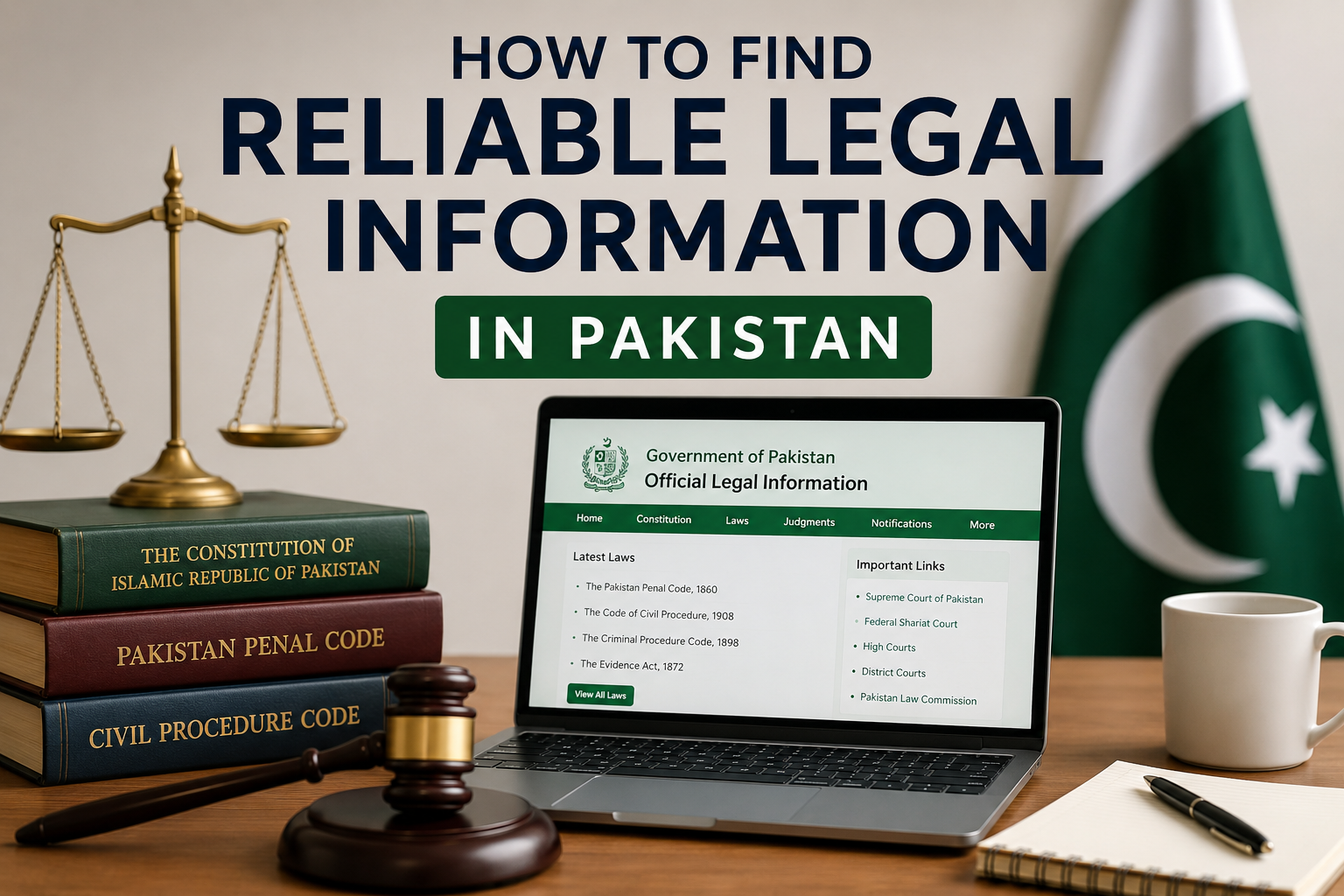
Whenever I am looking for Pakistani laws, my first preference is an official government source. Government websites can provide access to legislation, rules, notifications, policies, and other official information.
Pakistan has federal and provincial laws, so it is important to understand which government authority is responsible for the subject you are researching. A federal law may not answer a question that is controlled by provincial legislation.
For example, if I am researching a matter related to a provincial department, I would try to find the relevant provincial government website rather than depending entirely on a random legal blog.
Official sources are generally more reliable because they are connected to the authorities responsible for publishing legislation and official documents.
Check the Actual Law Instead of Only Reading Summaries
One of the biggest mistakes I see people make is relying only on articles that summarize the law.
Legal articles can be useful for understanding a topic in simple language, especially for beginners. However, a summary may leave out important details, exceptions, definitions, or procedural requirements.
When possible, I prefer to locate the actual law, ordinance, rule, notification, or judgment behind the explanation.
For example, if I want to understand a particular section of the Pakistan Penal Code or another Pakistani statute, I would look for the actual wording of that section. Then I can compare it with an explanation written in simpler language.
This approach helps me avoid relying on someone’s interpretation without checking the original legal material.
Use Reliable Pakistani Court Websites
Court decisions can be extremely important when researching a legal question. Laws do not exist in isolation. Courts interpret laws and explain how particular legal provisions apply to real situations.
For important legal research, I would consider information from the Supreme Court of Pakistan, relevant High Courts, and other appropriate judicial sources.
Court judgments can be difficult for beginners to read because they often contain legal terminology, references to previous cases, and detailed arguments. However, they can provide valuable information about how courts have interpreted a particular legal issue.
I recommend checking the case name, judgment date, court, and relevant legal provisions before relying on a judgment.
Pay Attention to the Date
Laws can change. Rules can be amended. Government notifications can replace earlier instructions. Court decisions can also affect how legal provisions are understood.
For this reason, I always think the date of legal information is important.
An article published several years ago may still appear in search results even when the law has changed. This is one reason why I would never assume that an old online article automatically represents the current law in Pakistan.
When researching a legal topic, I would check whether the source mentions amendments or recent developments. I would also compare older information with the latest official material available.
Understand the Difference Between Federal and Provincial Law
Pakistan has both federal and provincial legal structures, and this can make legal research confusing for beginners.
Some matters fall under federal legislation, while others are regulated by provincial laws and authorities. The applicable rules may therefore depend on the subject and the province involved.
For example, a person researching a matter involving a provincial department should pay attention to the relevant provincial legislation and official notifications.
In my opinion, understanding this distinction can save a lot of time. Instead of searching for a general answer to a legal question, I first try to identify which authority has jurisdiction over the issue.
Be Careful With Legal Blogs and Social Media
Legal blogs can be helpful because they often explain complicated subjects in simple language. I personally think educational websites can be useful for learning basic legal concepts.
However, I would not treat every blog post, Facebook post, YouTube video, or social media comment as legal authority.
Before trusting online legal information, I would ask a few basic questions.
Who published it?
When was it published?
Does it mention the relevant law?
Does it provide a source?
Has the law changed since publication?
Is the writer qualified to discuss the subject?
These questions can help separate useful educational content from unsupported claims.
Search Using Specific Legal Keywords
Another useful method is using specific search terms instead of very broad questions.
For example, instead of searching only for “property law in Pakistan,” I might search for the name of the relevant law, section, authority, or legal procedure.
Specific searches usually produce more useful results.
If I am researching employment law, I might search for the relevant legislation and official government department. If I am researching a court procedure, I might search for the relevant court rules and official judicial source.
Using specific legal keywords also makes it easier to compare information from multiple sources.
Verify Legal Definitions
Legal words can have meanings that are different from their everyday meanings.
Terms such as “appeal,” “bail,” “injunction,” “jurisdiction,” “limitation,” “decree,” and “appeal” can have specific legal meanings.
Therefore, I think beginners should avoid assuming that they understand a legal term simply because they use the word in ordinary conversation.
When I come across an unfamiliar legal term, I try to find its definition in the relevant legislation, court judgment, or reliable legal reference.
Understanding definitions can make the rest of the legal information much easier to follow.
Compare More Than One Reliable Source
I do not think one webpage should always be enough for an important legal question.
If the matter is significant, I prefer to compare information from several reliable sources. For example, I might compare the wording of legislation with an official notification and then look for relevant court decisions.
If two sources appear to contradict each other, that is a signal to investigate further rather than simply choosing the answer I prefer.
The purpose of comparing sources is not to make legal research unnecessarily complicated. It is to reduce the chance of relying on incomplete or outdated information.
Know When You Need a Lawyer
Online legal information can help me understand the basics, but it cannot always replace professional legal advice.
If a matter involves a court case, property dispute, criminal allegation, business agreement, inheritance issue, family dispute, or another serious legal problem, speaking with a qualified lawyer may be the safer approach.
A lawyer can consider the specific facts of a situation, examine documents, identify applicable laws, and explain possible legal options.
This is particularly important because two people may have similar looking problems but completely different legal circumstances.
Keep Copies of Important Documents
When researching a legal issue, I believe it is useful to keep copies of the documents and sources I have reviewed.
For example, I might save the relevant law, notification, judgment, application form, agreement, or official webpage for future reference.
This can help me return to the original information later instead of trying to remember what I read.
For important matters, I would also record the title of the law, relevant section, publication date, and source.
Do Not Rely on Search Engine Snippets
Search engines are excellent for finding information, but the short descriptions shown in search results are not a substitute for reading the actual source.
A snippet may contain only part of a sentence or may not explain an exception.
I prefer to open the source and read the relevant section in context.
This simple habit can prevent misunderstandings, especially when dealing with legal provisions that contain several conditions.
How I Check Legal Information Before Trusting It
My basic approach is simple. First, I identify the exact legal question. Second, I look for the relevant official source. Third, I check the actual legislation, rule, notification, or judgment. Fourth, I check the date and look for amendments. Fifth, I compare the information with another reliable source when the matter is important.
If the issue could have serious consequences, I would then consider speaking with a qualified lawyer.
This method takes a little more time, but I believe it is much safer than accepting the first answer that appears in a search engine.
Final Thoughts
Finding reliable legal information in Pakistan does not have to be difficult, but it does require careful research. In my opinion, the most important habit is learning to distinguish between official legal sources, professional explanations, personal opinions, and outdated information.
I would always give greater importance to official legislation, government notifications, court judgments, and other authoritative sources. Legal websites and educational articles can help explain difficult concepts, but they should ideally be checked against the original source.
Most importantly, online legal research should be used for education and preparation, not as a replacement for professional legal advice when a serious matter is involved.
By checking sources, verifying dates, understanding legal terminology, comparing reliable information, and consulting a qualified lawyer when necessary, anyone can become better at finding reliable legal information in Pakistan.
The goal is not simply to find an answer quickly. The goal is to find information that is accurate, current, relevant, and supported by a trustworthy legal source.