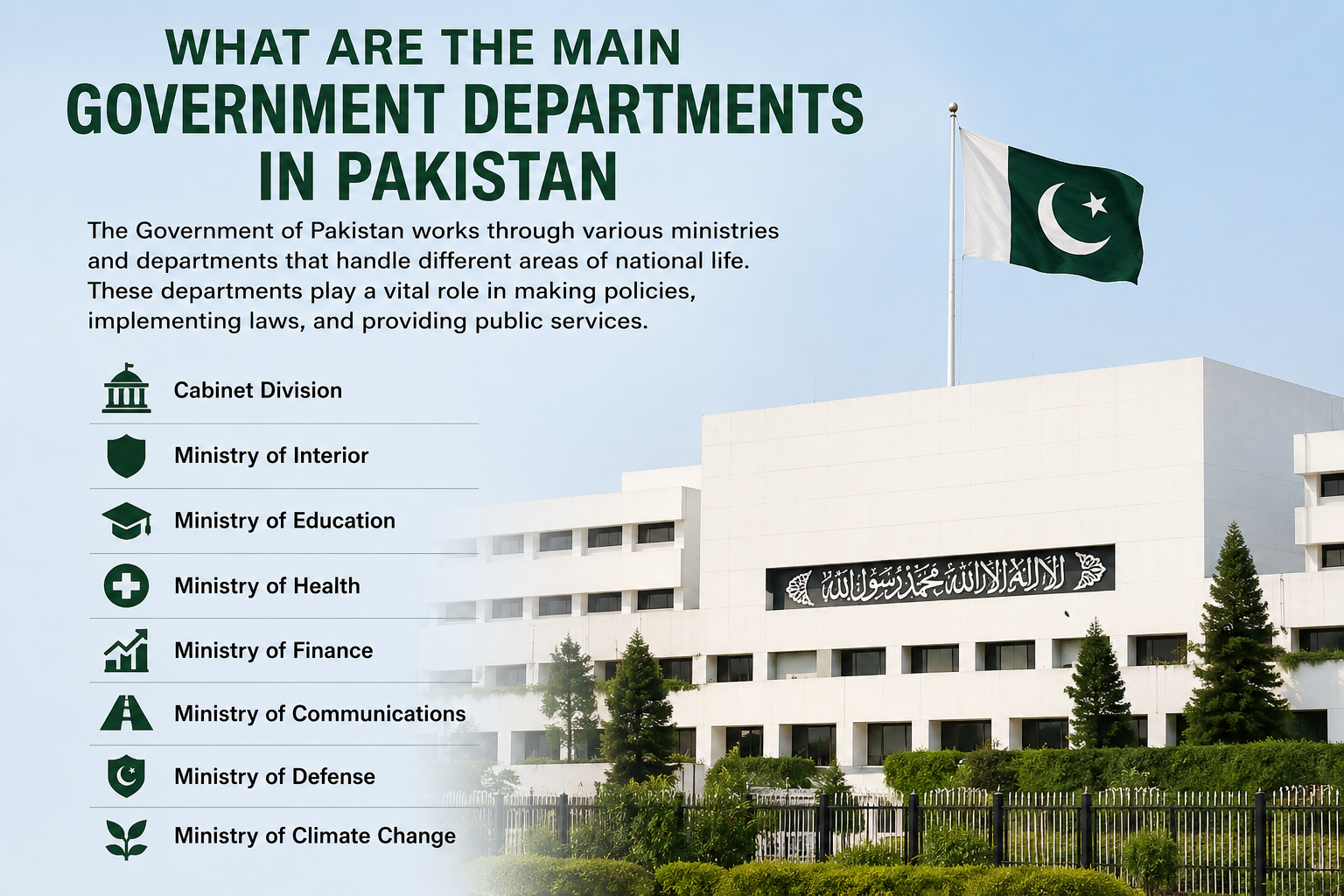
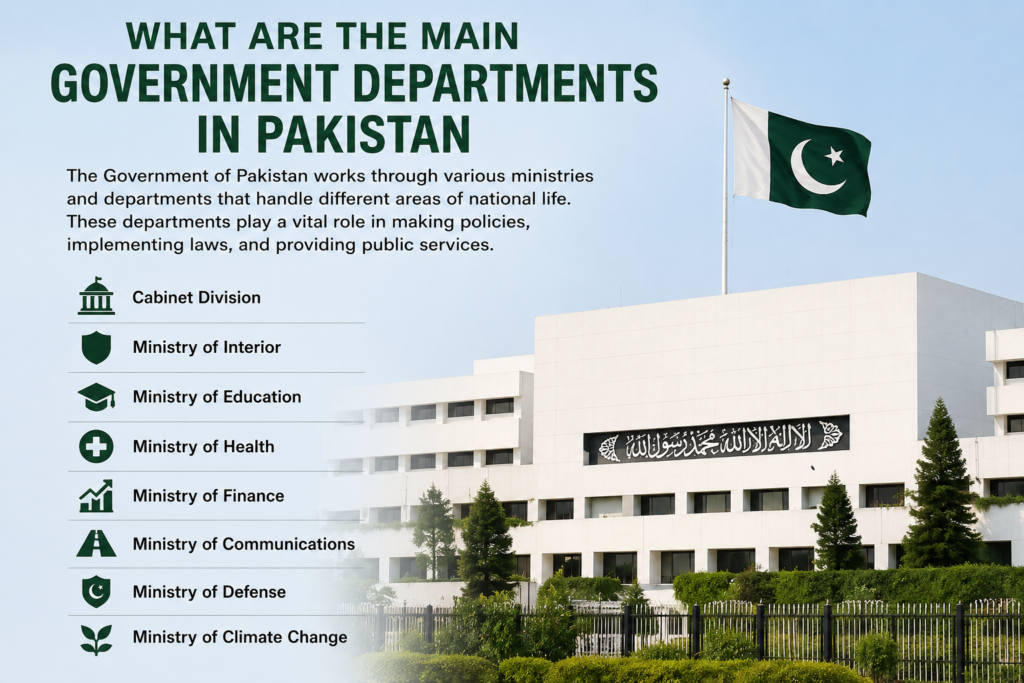
When we talk about the Government of Pakistan, many people think only about the Prime Minister, ministers, or Parliament. In my view, the government is much bigger than that. It works through different ministries, divisions, departments, attached organizations, and public institutions. Each one has a specific responsibility, and together they help run the country and provide important services to citizens.
Understanding the main government departments in Pakistan is useful because these departments affect almost every part of our daily lives. From education and healthcare to finance, defense, transportation, communication, and the environment, different government bodies are responsible for different areas.
In this article, I will explain the major government ministries and departments in Pakistan in simple language and discuss what they generally do.
How Government Departments Work in Pakistan
Pakistan has a federal system of government. At the federal level, the government deals with matters that concern the whole country. Provincial governments, on the other hand, manage many subjects within their respective provinces.
Federal ministries are usually headed by federal ministers who work under the political leadership of the Prime Minister. These ministries are supported by government officials who handle administration, policy implementation, planning, and coordination.
A ministry can also have divisions, departments, attached organizations, and other institutions working under its administrative control. This structure allows the government to divide responsibilities and manage a large country more effectively.
1. Cabinet Division
The Cabinet Division is an important part of the federal government structure. It helps with the coordination of government business and supports the functioning of the federal cabinet.
The Cabinet Division deals with administrative matters connected with the Cabinet and helps coordinate important decisions between different ministries and divisions.
In my opinion, this coordination role is extremely important because the government cannot work properly if every ministry operates completely separately. National policies often require cooperation between several government departments.
2. Ministry of Finance
The Ministry of Finance is one of the most important government departments in Pakistan because it deals with the country’s financial matters.
It is involved in preparing the federal budget, managing government finances, developing financial policies, and dealing with economic matters. The ministry also works on taxation policy, public expenditure, financial planning, and other issues connected with the national economy.
The federal budget is particularly important because it shows how the government plans to collect and spend public money. Decisions related to development projects, government salaries, public programs, and many other areas are connected with national financial planning.
3. Ministry of Interior
The Ministry of Interior deals with several important matters related to internal security, law enforcement coordination, immigration, and other internal affairs.
It works with various security and administrative institutions and plays a role in maintaining internal security and public order at the federal level.
For ordinary citizens, some of the services and institutions associated with the Interior Ministry can be especially important because they relate to identity documents, immigration, passports, security coordination, and other internal matters.
4. Ministry of Defence
The Ministry of Defence is responsible for important administrative and policy matters concerning Pakistan’s defense.
Pakistan has a significant national defense structure, and the ministry provides civilian administrative oversight and coordination related to defense affairs.
The Ministry of Defence also deals with matters concerning defense organizations and works with relevant institutions on national security and defense policies.
From my perspective, defense is not only about military operations. It also involves planning, administration, resources, international cooperation, and maintaining institutions that contribute to national security.
5. Ministry of Foreign Affairs
The Ministry of Foreign Affairs manages Pakistan’s diplomatic relations with other countries and international organizations.
It represents Pakistan in many international forums and helps develop foreign policy. Pakistani embassies and diplomatic missions around the world are also an important part of the country’s foreign relations system.
The ministry deals with international cooperation, diplomatic communication, treaties, regional relations, and matters involving Pakistan’s interests abroad.
I believe this department has a particularly important role because Pakistan’s relationships with neighboring countries and the wider international community can affect trade, security, education, investment, and many other areas.
6. Ministry of Federal Education and Professional Training
Education is another major area of government responsibility. At the federal level, the Ministry of Federal Education and Professional Training deals with education related matters that fall within federal jurisdiction.
The ministry works on educational policies, professional training, and coordination with relevant institutions.
Education itself is largely managed at the provincial level in Pakistan, but the federal government still has an important role in areas that require national coordination and standards.
In my opinion, education should remain one of the government’s highest priorities because a country’s long term development depends heavily on the quality of education and skills available to its people.
7. Ministry of National Health Services
The Ministry of National Health Services, Regulations and Coordination deals with health matters at the federal level.
Healthcare responsibilities in Pakistan are shared between federal and provincial institutions. The federal government has roles involving national health policies, coordination, regulation, and certain nationwide health programs.
Health is something that affects every family. Government departments working in this area can influence public health policies, disease prevention, medical standards, and coordination between different parts of the country.
8. Ministry of Communications
The Ministry of Communications is responsible for important matters related to roads and communication infrastructure under federal jurisdiction.
One of its major associated areas is the national highway network. Good roads are essential for trade, transportation, tourism, and economic activity.
When roads are maintained properly, people and businesses can move goods and services more efficiently. This is why I consider communication infrastructure an important part of economic development.
9. Ministry of Information and Broadcasting
The Ministry of Information and Broadcasting deals with information and broadcasting matters at the federal level.
It is involved in government communication, public information, media related policies, and the dissemination of official information.
In today’s digital world, government communication has become even more important. Citizens want quick and reliable information about policies, public services, emergencies, and national issues.
10. Ministry of Climate Change and Environmental Coordination
Climate change has become an increasingly important issue for Pakistan. The relevant federal ministry works on environmental and climate related policies and coordination.
Pakistan faces challenges such as floods, extreme weather, water stress, pollution, and environmental degradation. Government institutions working in this area can help develop policies related to climate adaptation, environmental protection, and sustainable development.
In my view, environmental protection should not be treated as a secondary issue. It directly affects agriculture, water, health, cities, and the economy.
11. Ministry of Energy
Energy is another critical area for Pakistan. Federal government institutions dealing with energy are responsible for important matters concerning electricity, petroleum, natural gas, and energy policy.
A reliable energy supply is necessary for homes, businesses, industries, hospitals, schools, and transportation.
Energy policy can also influence the cost of living and the competitiveness of Pakistani businesses. This makes the energy sector one of the most important areas of national economic planning.
12. Ministry of Commerce
The Ministry of Commerce focuses on Pakistan’s trade related matters.
It works on policies concerning exports and imports and plays a role in developing international trade relationships. Pakistan’s exports are important because they help the country earn foreign exchange and support businesses and employment.
Improving exports can involve many sectors, including textiles, agriculture, technology, manufacturing, and other industries.
13. Ministry of Industries and Production
The Ministry of Industries and Production deals with industrial development and production related policies.
Pakistan needs strong industries to create employment, increase production, encourage investment, and improve exports. Government policies in this area can influence industrial growth and the overall business environment.
From my point of view, industrial development is closely connected with economic stability because a productive industrial sector can create opportunities for millions of people.
14. Ministry of Planning, Development and Special Initiatives
The Ministry of Planning, Development and Special Initiatives plays a major role in national development planning.
It is associated with development programs, economic planning, and projects designed to improve infrastructure and public services.
Development planning is important because government resources are limited. The government needs to decide which projects should receive funding and how national development goals can be achieved.
Federal Government Departments and Provincial Governments
One important thing to understand is that not every government service is controlled directly by the federal government.
Pakistan has four provinces, and provincial governments have their own departments and ministries. For example, provincial governments have important responsibilities related to education, health, agriculture, local government, and other areas.
The exact division of responsibilities can depend on the Constitution and subsequent legal and administrative arrangements. This means that someone looking for a particular government service should first identify whether it is a federal or provincial responsibility.
Why Government Departments Matter
Government departments may sound like distant institutions, but their decisions can affect everyday life.
When we apply for a passport, use public infrastructure, attend a government school, visit a public hospital, pay taxes, travel on highways, or deal with government regulations, we are interacting with the public administration system in one way or another.
For me, the most important point is that government departments should work for the public interest. Good administration requires transparency, efficiency, accountability, and proper use of public resources.
Technology is also changing how citizens interact with government. Online applications, digital records, electronic payments, and online information portals can make government services easier and faster when they are implemented effectively.
Final Thoughts
The main government departments in Pakistan cover a wide range of responsibilities. Ministries and divisions dealing with finance, interior affairs, defense, foreign affairs, education, health, communications, energy, commerce, climate change, planning, and other areas all contribute to the functioning of the country.
I believe understanding these departments makes it easier for ordinary citizens to understand how Pakistan’s government works. Each department has its own responsibilities, but their work is connected. A strong economy needs energy and infrastructure. Better education supports economic growth. Good healthcare improves people’s quality of life. Effective foreign relations can support trade and investment.
The government system is complex, but learning the basic role of each major department makes it much easier to understand how decisions are made and how public services are delivered in Pakistan.