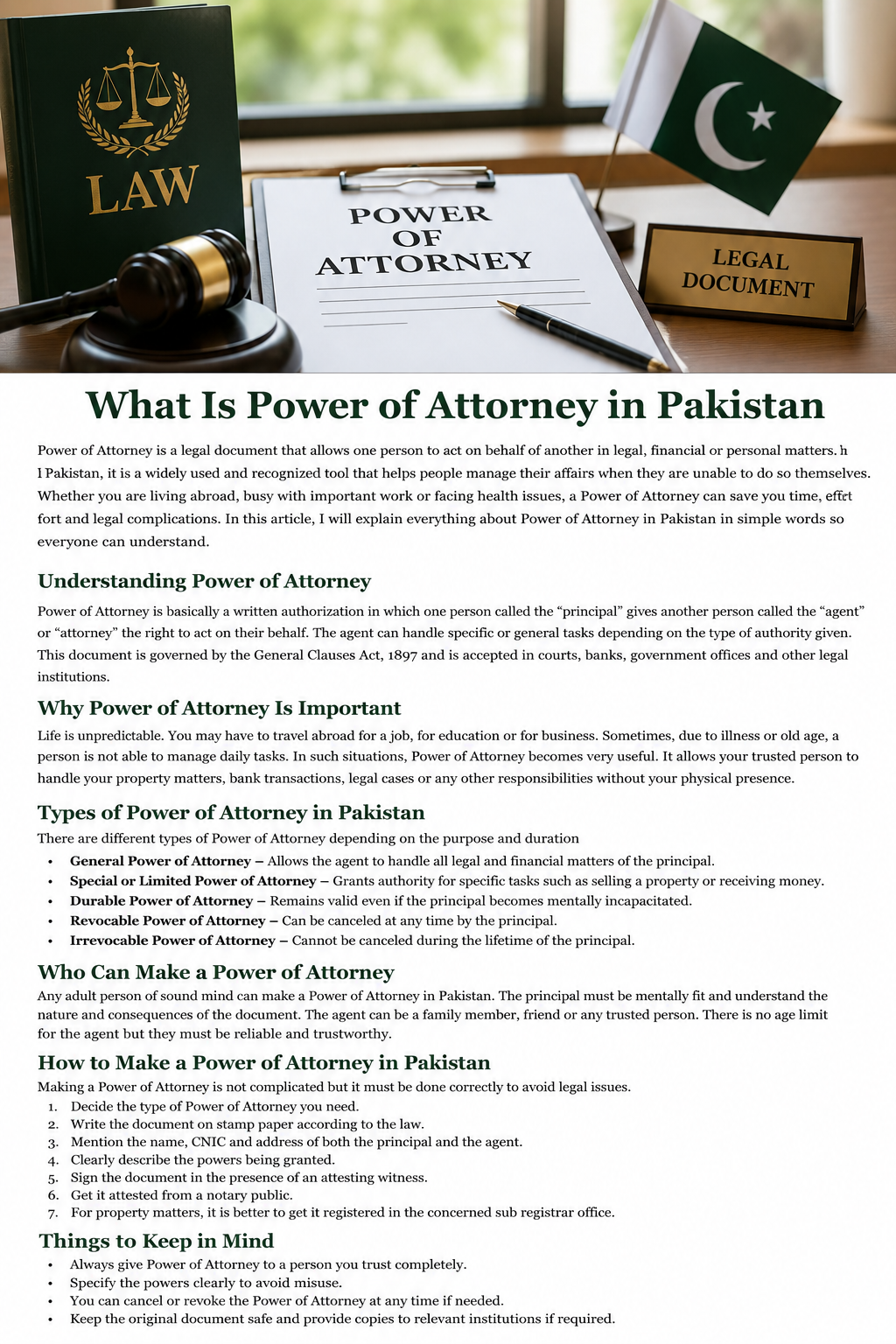
A Power of Attorney in Pakistan is a legal document through which one person gives another person the authority to act on their behalf. It can be useful when someone cannot personally handle their property, financial matters, legal work, business activities, or other responsibilities. In my view, Power of Attorney is one of those legal documents that can make life much easier when it is prepared carefully and given to the right person.
People often need a Power of Attorney when they are living abroad, travelling for a long period, dealing with property matters, or unable to visit a government office, bank, court, or other institution personally. However, because this document gives another person legal authority, it should never be signed casually.
In this article, I will explain what Power of Attorney means in Pakistan, its common types, how it is prepared, where it may be used, and what important things you should understand before giving someone this authority.
What Is a Power of Attorney?
A Power of Attorney is a written legal authorization given by one person to another. The person giving the authority is commonly called the principal, while the person receiving the authority is called the attorney or agent.
The agent can perform only those actions that are permitted by the Power of Attorney. For example, if someone gives another person authority to manage a particular property, the agent does not automatically receive unlimited authority over every asset of the principal.
This is why I believe the wording of a Power of Attorney is extremely important. The document should clearly explain what the agent can and cannot do.
Why Is Power of Attorney Important in Pakistan?
There are many situations where a Power of Attorney can be useful. One common example is when a Pakistani citizen is living overseas and owns property in Pakistan.
Imagine someone living in the United Kingdom who owns a house or agricultural land in Pakistan. If that person needs someone in Pakistan to handle a specific legal or property related matter, travelling back every time may not be practical. A properly prepared Power of Attorney can allow a trusted person to handle authorized tasks on their behalf.
It may also be useful for business matters, banking activities, court related work, documentation, and property management, depending on the authority granted.
For me, the biggest benefit is convenience. At the same time, the biggest concern is misuse. Giving legal authority to another person means choosing someone you can trust.
Main Types of Power of Attorney in Pakistan
Power of Attorney can take different forms depending on the purpose and authority being granted.
General Power of Attorney
A General Power of Attorney gives broad authority to the agent to perform several types of activities on behalf of the principal.
Depending on its wording, it may cover financial, business, property, legal, or administrative matters.
Because the authority can be broad, a person should carefully consider whether a General Power of Attorney is actually necessary. In many cases, granting only limited authority may be safer.
Special or Specific Power of Attorney
A Special Power of Attorney gives authority for a particular purpose or transaction.
For example, a person may authorize someone to complete a specific property related transaction or represent them for a particular legal matter.
I personally consider a specific Power of Attorney a useful option when there is only one task to be completed because it can reduce unnecessary authority.
Revocable Power of Attorney
A revocable Power of Attorney is one that can generally be cancelled by the principal, subject to the terms of the document and applicable law.
If the purpose for which the authority was given has been completed, the principal may take steps to revoke the authority where legally appropriate.
Irrevocable Power of Attorney
The term irrevocable Power of Attorney should be treated carefully. It does not simply mean that a person can never cancel the document under any circumstances. Its legal effect can depend on the circumstances, wording, consideration, and applicable law.
For this reason, anyone considering an irrevocable Power of Attorney should obtain proper legal advice before signing it.
Who Can Give a Power of Attorney?
Generally, a person who has legal capacity and understands the nature and consequences of the document can grant a Power of Attorney.
The principal should understand what authority is being given and to whom it is being given. The person receiving the authority should also be clearly identified.
Names, CNIC details, addresses, and other relevant identification information should be written accurately. Any mistake in important identification information can create unnecessary complications later.
How to Make a Power of Attorney in Pakistan
The exact procedure can vary depending on the purpose of the document and where it is being executed. However, some important steps are commonly involved.
First, decide exactly why you need the Power of Attorney. Do not start with a broad document if you only need someone to perform one specific task.
Second, clearly identify the principal and the agent.
Third, explain the powers being granted. If the agent is authorized to deal with a particular property, the property should be properly identified.
Fourth, the document should be executed on the appropriate stamp paper or in the legally required form.
Fifth, signatures and attestation should be completed according to the applicable requirements.
For certain transactions, particularly those involving immovable property, registration or other formal requirements may apply. The relevant registrar or authority should be consulted before relying on the document.
Power of Attorney for Property in Pakistan
Property is one of the most common reasons people use a Power of Attorney.
A property Power of Attorney may authorize an agent to perform specific actions relating to land, a house, an apartment, or another property. However, the authority should be written carefully.
For example, if someone only wants an agent to manage a property, the document should not unnecessarily give that person broad authority to sell or transfer the property.
Property transactions can involve significant financial value, so I would strongly recommend checking the document with a qualified lawyer before signing it.
Power of Attorney for Overseas Pakistanis
Overseas Pakistanis frequently need Power of Attorney services because they may have property, family, business, or legal matters in Pakistan.
A person living abroad may need to authorize a family member or another trusted individual to handle a matter in Pakistan.
However, documents executed outside Pakistan can involve additional requirements relating to attestation, authentication, consular procedures, or registration. The exact process may depend on the country where the document is signed and the purpose for which it will be used.
Anyone preparing a Power of Attorney from abroad should check the current requirements of the relevant Pakistani mission and the authority in Pakistan where the document will be presented.
Can a Power of Attorney Be Cancelled?
In many situations, a principal can revoke a Power of Attorney, but the legal position depends on the type of authority, its wording, the transaction involved, and applicable law.
Revocation should be properly documented and communicated to the relevant parties and institutions where necessary.
Simply telling the agent verbally that the authority has ended may not always be enough to protect the principal from practical problems.
If the Power of Attorney has already been used for a property or financial transaction, the situation can become more complicated. Professional legal advice can help determine the appropriate steps.
Important Things to Check Before Signing
Before signing a Power of Attorney in Pakistan, I would personally check several things.
First, make sure you completely understand the document.
Second, give authority only to someone you genuinely trust.
Third, avoid unnecessary powers.
Fourth, check the spelling of names, CNIC numbers, addresses, and property details.
Fifth, make sure the document follows the applicable legal and registration requirements.
Sixth, keep the original document safely stored.
Finally, consider getting professional legal advice if the Power of Attorney involves property, substantial money, business ownership, litigation, or another major legal interest.
Common Mistakes People Make
One common mistake is giving someone more authority than necessary.
Another mistake is using a generic Power of Attorney without checking whether it actually covers the intended transaction.
Some people also fail to update or revoke an old Power of Attorney after their circumstances change.
Another serious mistake is choosing an agent simply because they are a relative. Family relationships can create trust, but important legal authority should still be given only after careful consideration.
Final Thoughts
In simple words, a Power of Attorney in Pakistan allows one person to authorize another person to act on their behalf. It can be extremely useful for people who cannot personally manage their legal, property, business, financial, or administrative affairs.
From my point of view, the most important thing is not simply preparing the document. The real importance is understanding exactly what authority you are giving away.
A carefully drafted Special Power of Attorney can sometimes be more appropriate than a broad General Power of Attorney. The agent should be trustworthy, the powers should be clearly written, and all applicable legal formalities should be followed.
If property, large financial amounts, litigation, or overseas documentation is involved, getting advice from a qualified Pakistani lawyer is a sensible step before signing anything.
A Power of Attorney is a useful legal tool, but it should always be treated with care because the person you authorize may be able to make important decisions on your behalf.