
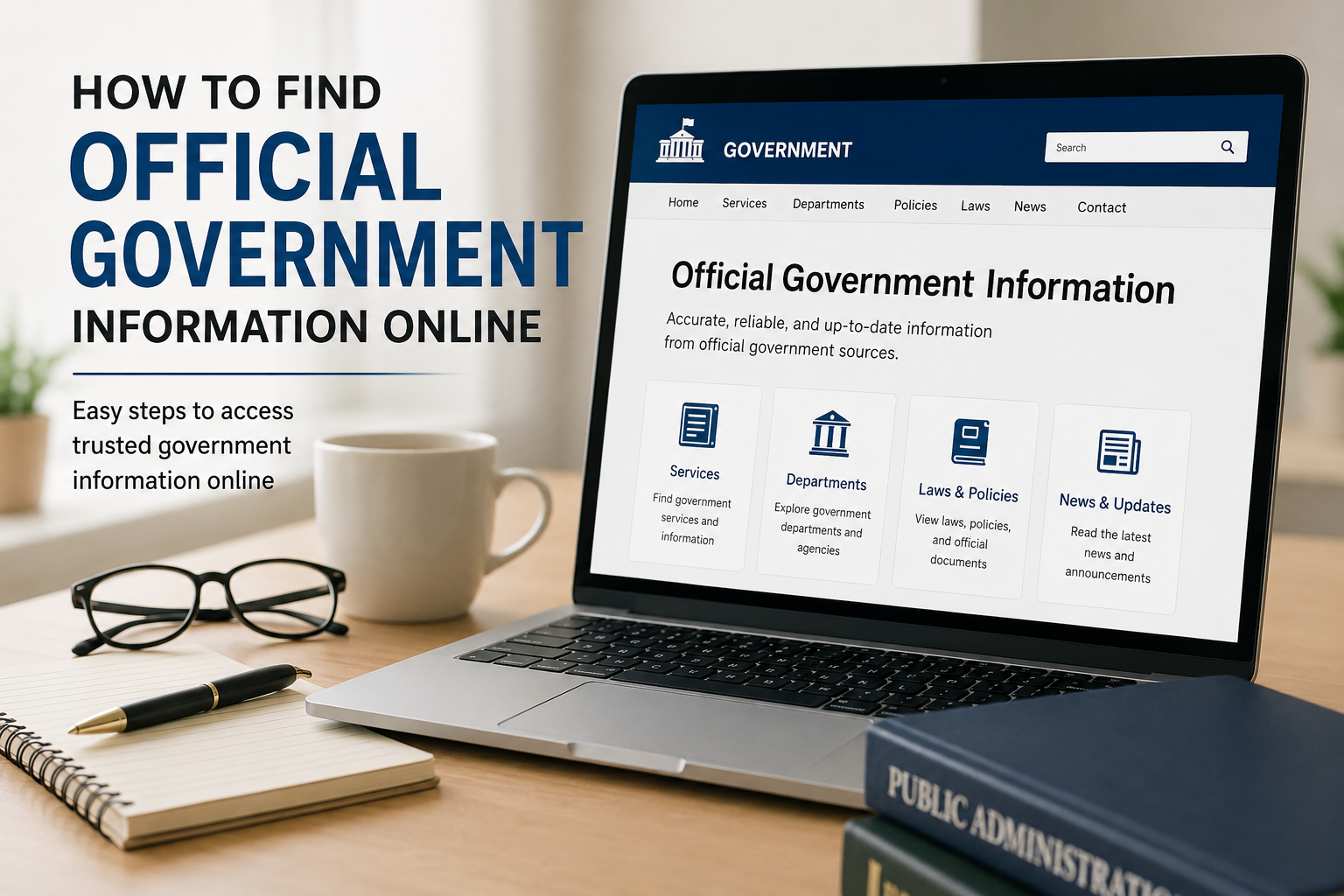
Finding official government information online has become much easier than it was in the past. Today, almost every government department provides important information through its official website. People can use these websites to learn about laws, government services, policies, public announcements, departments, applications, taxes, education, identity documents, and many other matters.
In my view, the biggest challenge is not finding information. The real challenge is knowing whether the information is official, accurate, and up to date. Search engines can show thousands of results, but not every website that discusses a government topic is a government website. Some websites publish useful explanations, while others may contain outdated or incorrect information.
That is why I believe learning how to find official government information online is an important digital skill. In this article, I will explain the simple methods I use to find reliable government information and how you can avoid common mistakes.
Why Official Government Information Matters
Government information can affect important decisions in our daily lives. For example, if I want to understand a government law, apply for a public service, check a policy, or find information about a government department, I prefer to start with the official source.
Official government websites are generally the best place to find original documents, announcements, forms, rules, policies, and contact details. They can also provide information about eligibility requirements, application procedures, fees, deadlines, and required documents.
Using an official government source can also help reduce confusion. Many blogs and social media pages summarize government information, but their content may not include the complete details.
Start With a Search Engine
One of the easiest ways to find government information online is to use a search engine. Instead of searching for a broad phrase, I recommend using specific keywords.
For example, instead of searching for:
“government information”
you can search for:
“Pakistan government official website”
or:
“Pakistan Ministry of Finance official website”
or:
“official government tax information Pakistan”
Adding the name of the department or ministry can make your search much more accurate.
If you are looking for information about a particular country, always include the country’s name in your search. This helps the search engine understand exactly what type of information you need.
Check the Website Address Carefully
One of the most important steps is checking the website address before trusting the information.
Government websites often use official government domains. In Pakistan, for example, many federal government websites use the .gov.pk domain. However, the exact domain can vary depending on the department or service, so I always check the website carefully rather than assuming that every website discussing government matters is official.
A website can look professional and still be unofficial. This is why the domain name, organization name, contact details, and other information should be checked.
I also avoid relying on websites that make strong claims but do not clearly identify the government department or organization responsible for the information.
Find the Official Government Department
If I need information about a specific subject, I try to identify the government department responsible for that subject.
For example, information about taxation may come from a tax authority, while information about education may come from an education ministry or department.
This approach is useful because government responsibilities are divided among different departments. Finding the correct department can take you directly to the original information.
When searching online, use the department name together with your topic. This can make the results much more relevant.
Look for Official Documents
Sometimes the information you need is not explained in a simple article. It may be available as an official document.
Government websites commonly publish documents such as laws, rules, notifications, policies, reports, forms, circulars, and public notices.
When I find an important document, I check its title, publication date, issuing department, and other identifying information. This helps me understand whether the document is current and relevant.
For legal or administrative information, reading the original document can be more reliable than depending entirely on someone’s summary.
Check the Publication Date
Government information can change over time. A policy that was correct several years ago may have been replaced or updated.
This is why I always look for a publication date, update date, notification date, or revision information when available.
If two websites provide different information, I compare their dates and give greater attention to the newer official source.
This simple habit can prevent many mistakes.
Verify Important Information From More Than One Official Source
For important topics, I believe it is useful to verify information.
For example, if one government department announces a new policy, another official government page may provide related information about how that policy is implemented.
This does not mean that every piece of information needs to be checked repeatedly. However, when the topic involves laws, taxes, applications, public services, or important deadlines, additional verification can be helpful.
The goal is to make sure that the information is not outdated or taken out of context.
Use Official Government Search Features
Many government websites have their own search boxes. I find these particularly useful when a website contains a large amount of information.
Instead of opening dozens of pages, I can enter a keyword related to the subject I need.
For example, if I am looking for information about a particular government form, I can search the website for the form name or related keyword.
Government websites can sometimes have complicated navigation, so using their internal search feature can save time.
Be Careful With Social Media
Social media is useful for discovering government announcements, but I would not treat every social media post as the final source of information.
Government departments may operate official social media accounts where they share announcements and links. However, other users can also share screenshots, edited images, or statements without proper context.
If I see an important government announcement on social media, I prefer to locate the original announcement on the official government website.
This is especially important when information involves deadlines, laws, public services, or major policy changes.
Avoid Relying Only on Blogs
Blogs can be useful because they often explain complicated topics in simple language. However, a blog should not automatically be treated as an official source.
I use blogs and educational websites to understand a topic, but when I need the exact government rule, notification, law, form, or requirement, I prefer to check the official government source.
This approach gives me both benefits. A blog can make a complicated subject easier to understand, while an official source provides the original information.
Learn to Identify Fake Government Websites
Another important online skill is recognizing websites that may try to look official.
A suspicious website may use government logos, official sounding language, or names that resemble real departments. That does not necessarily make it an official government website.
Before entering personal information, uploading documents, or making payments, I check the website address and confirm that the website belongs to the appropriate government organization.
I also look for official contact information and links to other government resources.
If something feels unusual, I stop and verify the website before continuing.
Check Contact Information
A genuine government website normally provides some form of official contact information.
Depending on the department, this may include an office address, telephone number, email address, help desk, or other communication method.
When I am unsure about a particular government service, I use the contact information provided on the official website instead of relying on an unknown third party.
This can be especially useful when the website instructions are unclear.
Search for Laws and Government Policies
If you want to find official laws or government policies online, start by identifying the responsible government institution.
Search using specific terms such as the name of the law, subject, department, or policy.
For example, instead of searching only for “Pakistan law,” use the exact name of the law if you know it.
You should also check whether the document has been amended, replaced, or updated. Laws and policies can change, so an older copy may not represent the current position.
Keep Records of Important Information
When I find important government information online, I like to keep a record of where I found it.
For example, I may save the official webpage, download an official document, or note the date on which I checked the information.
This is particularly useful when dealing with applications, deadlines, government forms, or administrative procedures.
Keeping a record also makes it easier to return to the same information later.
Use Specific Keywords for Better Results
Good search keywords can make finding official government information much easier.
Useful phrases include:
“official government website”
“government department official website”
“official government notification”
“government policy official document”
“official government form”
“government law official document”
“government services official website”
“latest government notification”
The more specific your search is, the easier it becomes to find the information you actually need.
Final Thoughts
In my opinion, finding official government information online is mostly about developing good search habits. The internet provides an enormous amount of information, but not all of it deserves the same level of trust.
I always try to identify the responsible government department, check the official website address, look at publication dates, read original documents, and verify important information before making decisions.
Government websites can sometimes be difficult to navigate, but with practice, finding official information becomes much easier. Instead of depending completely on social media posts, random websites, or search snippets, I believe it is better to go directly to the original government source whenever possible.
The next time you need information about a government law, department, policy, form, public service, or official announcement, start with a specific search and carefully check the source. A few extra minutes of verification can help you avoid outdated information, misunderstandings, and potentially serious mistakes.
Most importantly, remember that online information should be checked according to its source and date. When the information is important, go back to the official government website and confirm the details before taking action.