An affidavit is a legal document in which a person makes a written statement and confirms that the information provided is true to the best of their knowledge. In Pakistan, affidavits are commonly used in courts, government offices, educational institutions, property matters, immigration cases, and many other official situations.
In my view, an affidavit may look like a simple piece of paper, but it can have serious legal importance. When someone signs an affidavit, they are formally confirming the truth of the statements written in it. That is why an affidavit should always be prepared carefully and checked before signing.
In this article, I will explain what an affidavit is in Pakistan, why it is used, what information it normally contains, how it is prepared, and what people should know before signing one.
What Is an Affidavit?
An affidavit is a written statement made by a person under oath or solemn affirmation. The person making the statement is commonly called the deponent. The affidavit contains facts or declarations that the person believes to be true.
For example, if someone needs to confirm their residential address, family relationship, financial information, educational details, or ownership of a particular property, an affidavit may be required as supporting evidence.
The important point is that an affidavit is not simply an ordinary written statement. It is a formal declaration that carries legal significance.
In Pakistan, the exact requirements for an affidavit can depend on the purpose for which it is being prepared and the institution or authority requesting it.
Why Is an Affidavit Used in Pakistan?
There are many situations where an affidavit may be required. I have found that people usually come across affidavits when dealing with courts, government departments, property transactions, educational institutions, or other official procedures.
Some common purposes include:
Court Cases
Affidavits are frequently used in legal proceedings. A person may submit an affidavit to present facts, confirm information, or support an application before a court.
Depending on the case, the court may require an affidavit from a party, witness, applicant, or another person who has relevant information.
Property Matters
Affidavits can also be used for certain property related matters. For example, a person may be asked to provide a declaration regarding ownership, possession, inheritance, or other property information.
The exact documents required depend on the transaction and the relevant authority.
Educational Matters
Students may sometimes need affidavits for educational purposes. These can include declarations regarding personal information, gaps in education, financial circumstances, guardianship, or other matters requested by an educational institution.
Government Applications
Various government offices may request affidavits as part of an application or verification process. The purpose is generally to obtain a formal declaration from the applicant.
Family and Personal Matters
Affidavits may also be used for personal or family related declarations. Examples can include declarations concerning relationships, names, guardianship, marital status, or other factual information.
The important thing is to understand why the affidavit is being requested before preparing it.
What Information Does an Affidavit Contain?
A typical affidavit in Pakistan may contain several important details.
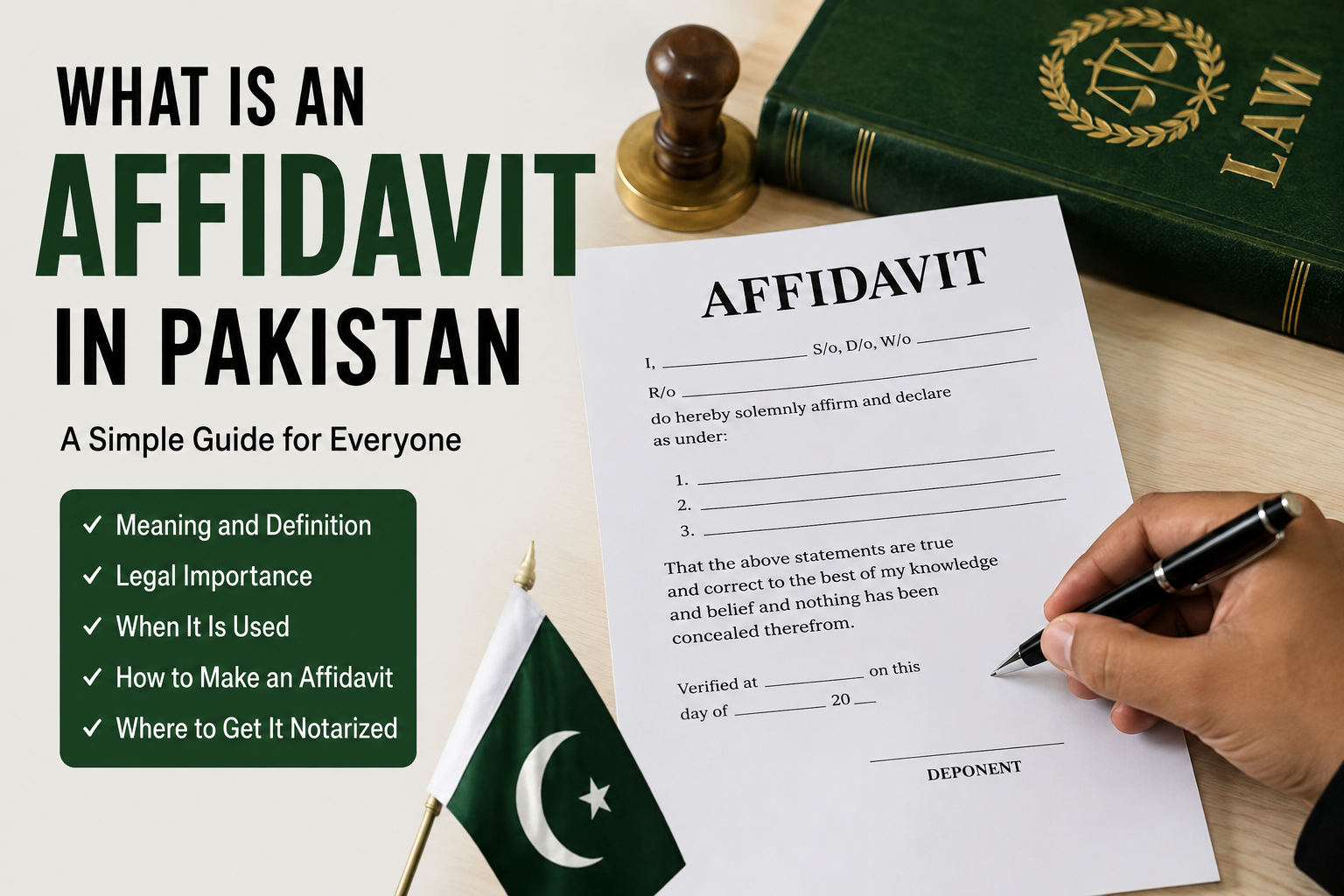
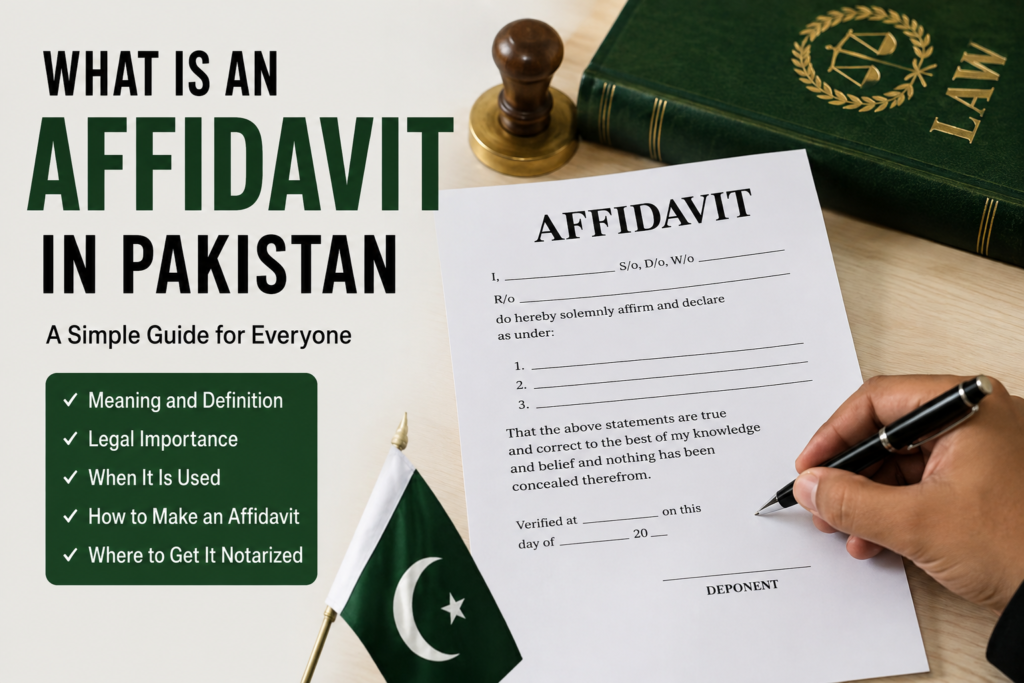
First, it normally identifies the person making the affidavit. This can include their name, father’s or husband’s name, address, and other identifying information where required.
Next comes the main statement or declaration. This is the section where the person explains the facts they are confirming.
The affidavit may contain numbered paragraphs because this makes individual statements easier to identify.
At the end, the person making the affidavit signs it. There may also be a verification section confirming that the statements are true according to the person’s knowledge and belief.
The document may then be attested by an authorized person according to the requirements applicable to that particular affidavit.
What Is an Affidavit on Stamp Paper?
Many people in Pakistan know affidavits as documents prepared on stamp paper. Depending on the purpose and applicable requirements, an affidavit may be prepared using the required stamp paper.
The value or type of stamp paper can depend on the nature of the document and the applicable provincial rules.
Because these requirements can change, I would not recommend choosing a stamp paper value based only on an old sample found online. It is better to confirm the current requirement with the relevant office, court, lawyer, or authorized professional handling the matter.
How to Make an Affidavit in Pakistan
Making an affidavit is generally straightforward when you already know what declaration is required.
The first step is to understand the exact purpose of the affidavit. You should know what the receiving authority wants you to declare.
The second step is to prepare the information accurately. Names, addresses, dates, identification details, and other important facts should be checked carefully.
The next step is to write the declaration in a clear and formal manner. The language should be simple enough to understand while still accurately describing the facts.
After preparing the document, it should be reviewed carefully. I believe this is one of the most important steps because even a small mistake in a name, date, address, or statement can create unnecessary problems.
The affidavit is then signed and attested according to the applicable requirements.
Who Can Attest an Affidavit in Pakistan?
The person who can attest an affidavit depends on the type of affidavit and the requirements of the relevant authority.
In many situations, affidavits are presented before a person authorized to administer oaths or perform the required attestation. Notaries and other authorized officials may be involved depending on the circumstances.
However, it is important not to assume that every affidavit can be attested in exactly the same way. A court, government department, embassy, university, or other organization may have its own requirements.
Before signing or submitting the document, I recommend checking the instructions given by the authority requesting the affidavit.
Is an Affidavit Legally Binding?
An affidavit has legal importance because the person making it formally declares that the statements are true.
This means people should never treat an affidavit as a document that can be prepared casually.
If a person knowingly provides false information in an affidavit, there can be legal consequences depending on the circumstances and applicable law.
For this reason, anyone signing an affidavit should read every statement carefully and make sure that the information is accurate.
If the affidavit concerns an important legal dispute, property matter, financial issue, or court proceeding, obtaining professional legal advice can be a sensible decision.
Difference Between an Affidavit and an Ordinary Declaration
An affidavit and an ordinary declaration can look similar because both may contain written statements.
The main difference is the formal nature of an affidavit. An affidavit is made as a sworn or affirmed statement and is normally completed according to specific legal or administrative requirements.
An ordinary declaration may simply be a written confirmation without the same formal process.
This distinction is important because the organization requesting the document may specifically require an affidavit rather than a simple declaration.
Can an Affidavit Be Used as Evidence?
An affidavit can be used in legal proceedings as a form of evidence or supporting material, depending on the circumstances and the applicable procedural rules.
However, an affidavit does not automatically prove every statement written inside it. The court may consider the affidavit together with other evidence and legal arguments.
This is why I think people should avoid assuming that signing an affidavit automatically makes every claim legally accepted.
The value of an affidavit depends on the facts, circumstances, purpose, and legal process involved.
Common Mistakes People Make With Affidavits
One common mistake is copying an old affidavit without checking whether its wording is suitable for the current situation.
Another mistake is providing incorrect personal information. Even a small spelling difference in a name can cause difficulties when the affidavit is being submitted with other official documents.
Some people also sign the document without reading it properly. This is something I strongly recommend avoiding.
Another problem is using an affidavit for a purpose that requires a different document. Before preparing one, make sure the receiving authority has specifically asked for an affidavit.
Finally, people sometimes ignore attestation requirements. An affidavit that has not been properly completed or attested may not be accepted by the organization requesting it.
Can You Write an Affidavit Yourself?
In many simple situations, a person can prepare the wording of an affidavit themselves. However, the appropriate wording depends heavily on the purpose.
For a straightforward declaration, a clear format may be sufficient if it meets the requirements of the relevant authority.
For complicated legal matters, I would prefer getting advice from a qualified lawyer. Legal documents are not the best place to guess about wording, particularly when property, inheritance, court proceedings, or significant financial interests are involved.
How Much Does an Affidavit Cost in Pakistan?
The cost of an affidavit can vary depending on several factors.
There may be a cost associated with stamp paper, drafting, printing, attestation, notarial services, or other administrative requirements.
There is no single universal cost for every affidavit because the requirements can differ according to the purpose and location.
If you need an affidavit for a specific government department, court, university, embassy, or other organization, it is better to ask that organization about its current requirements.
Final Thoughts
In simple words, an affidavit in Pakistan is a formal written statement in which a person declares that certain information or facts are true. It is commonly used for court cases, government applications, property matters, education, family issues, and many other official purposes.
From my point of view, the most important thing to remember is that an affidavit should never be treated as just another form. Once you sign it, you are formally confirming the statements contained in it.
Always check the purpose of the affidavit, provide accurate information, review every detail, and follow the attestation requirements of the relevant authority.
If the matter is complicated or legally important, professional legal advice can help you avoid mistakes. A properly prepared affidavit can make an official process much smoother, while an inaccurate or incorrectly prepared document can create unnecessary problems.
Understanding what is an affidavit in Pakistan is useful for anyone who may need to deal with courts, government departments, property documents, educational institutions, or other official procedures. The better you understand the purpose of an affidavit before signing it, the more confidently you can handle the process.
SEO Keywords: what is an affidavit in Pakistan, affidavit meaning in Pakistan, affidavit format Pakistan, affidavit on stamp paper, affidavit attestation in Pakistan, how to make an affidavit in Pakistan, affidavit requirements Pakistan, legal affidavit Pakistan, affidavit for court in Pakistan