When I first started learning about the Parliament of Pakistan, I found the difference between the National Assembly and Senate a little confusing. Both are important parts of Parliament, both participate in making laws, and both represent the people of Pakistan in different ways. However, their roles, membership, elections, terms, and constitutional responsibilities are not exactly the same.
In this article, I will explain the difference between the National Assembly and Senate in simple language. My aim is to make this topic easier for students, voters, and anyone who wants to understand how the Parliament of Pakistan works.
What Is the National Assembly?
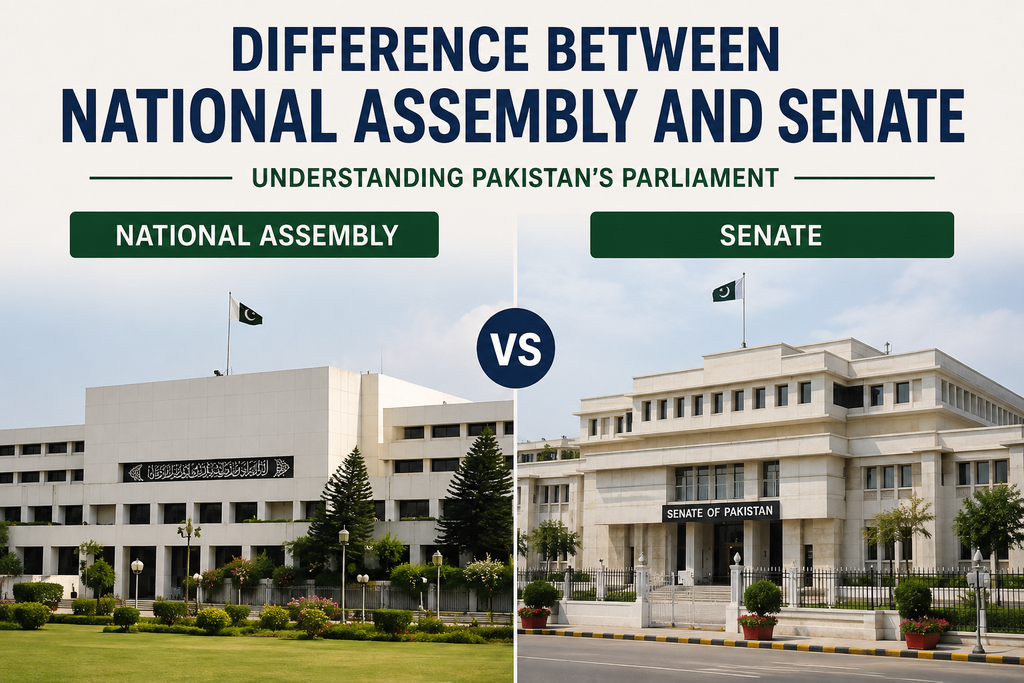
The National Assembly is the lower house of the Parliament of Pakistan. It is one of the most important representative institutions in the country because its members are directly elected by voters.
Members of the National Assembly are known as Members of the National Assembly, commonly called MNAs. General seats are contested through elections, while seats are also reserved for women and non Muslim citizens according to the constitutional system.
The National Assembly plays a major role in legislation, government formation, financial matters, and public accountability. The Prime Minister is elected by the National Assembly, which means the house has a central role in determining the federal government.
From my point of view, the National Assembly is especially important because it provides a direct connection between voters and the federal legislative system. When citizens vote in a general election, they are helping choose representatives who will sit in the National Assembly.
What Is the Senate?
The Senate is the upper house of the Parliament of Pakistan. Unlike the National Assembly, senators are not directly elected by the general public. They are elected by the members of the provincial assemblies and through other constitutional arrangements for representation.
The Senate was created to provide equal representation to the provinces. This is an important difference between the two houses. Representation in the National Assembly is largely connected to population, while the Senate gives the provinces a more balanced voice.
The Senate therefore has an important role in protecting the interests of the provinces within the federal parliamentary structure.
I think this arrangement makes sense in a federation such as Pakistan. Larger provinces have more seats in the National Assembly because of population, while the Senate provides smaller provinces with stronger representation at the federal level.
National Assembly vs Senate
The simplest way to understand the difference is to look at their main characteristics.
The National Assembly is the lower house, while the Senate is the upper house.
The National Assembly is directly connected with voters through general elections. Senators are elected through an indirect electoral system.
The National Assembly has a limited term, while the Senate is a continuing house. Senators serve fixed terms, with a portion of the membership retiring periodically rather than the entire Senate ending at once.
Another major difference is their role in government formation. The Prime Minister is elected by the National Assembly. The Senate does not elect the Prime Minister.
The two houses also have different responsibilities in relation to money bills. The National Assembly has the primary constitutional role in financial legislation, while the Senate can make recommendations concerning money bills within the constitutional framework.
Difference in Representation
Representation is one of the most important differences between the National Assembly and Senate.
The National Assembly represents citizens largely according to population. This means areas with larger populations have greater representation.
The Senate, on the other hand, is designed to provide provincial representation. The constitutional structure gives the provinces representation in the Senate that is intended to prevent population alone from determining the balance of the upper house.
This distinction is important because Pakistan is a federation. Provinces have their own governments and legislative institutions, while the federal government deals with matters that fall within federal authority.
In my view, having two different methods of representation helps create a balance between population based representation and provincial interests.
How Members Are Elected
The method of election is another major difference.
Members of the National Assembly are elected through general elections. Citizens vote for candidates in their constituencies. The candidate who meets the required electoral conditions becomes the representative for that constituency.
Reserved seats are filled according to the constitutional and legal system rather than through direct voting by the entire electorate.
Senators are elected differently. Members of the provincial assemblies participate in elections for provincial seats in the Senate. Other Senate seats are filled according to the relevant constitutional arrangements.
This means an ordinary voter does not normally cast a direct vote for an individual senator in the same way that the voter chooses an MNA.
Difference in Term
The National Assembly and Senate also differ in their terms.
The National Assembly normally has a five year constitutional term unless it is dissolved earlier according to the Constitution.
The Senate is a permanent or continuing house. Its entire membership does not retire at the same time. Senators serve six year terms, with half of the members retiring every three years.
I consider this one of the most interesting differences because it provides continuity. Even when the National Assembly changes after a general election, the Senate continues to function because only part of its membership changes at a time.
Role in Law Making
Both houses participate in the legislative process, which means neither house should be viewed as unimportant.
Ordinary legislation generally goes through the parliamentary process involving both houses. A bill may begin in one house and then proceed through the constitutional procedure before becoming law.
The National Assembly and Senate therefore work together in law making. Their debates allow members to examine proposed legislation, raise concerns, suggest changes, and discuss matters affecting the country.
However, money bills have special constitutional rules. The National Assembly has the primary role in relation to financial legislation because it directly represents taxpayers through elected constituencies.
Role of the Prime Minister
The National Assembly has a particularly important role in choosing the Prime Minister.
After a general election, members of the National Assembly participate in the election of the Prime Minister. The Prime Minister must maintain the required support in the National Assembly to continue governing.
The Senate does not elect the Prime Minister.
This is another reason why the National Assembly is central to the formation and survival of the federal government.
The Senate, however, remains important for legislation, oversight, debate, and representation of the provinces.
Why Pakistan Needs Both Houses
It may seem easier to have only one parliamentary house, but I believe the two house system serves an important purpose.
The National Assembly gives greater weight to population based representation and directly elected members. The Senate provides a forum where provincial representation has greater importance.
If only population were considered, smaller provinces could have less influence in the federal legislative process. The Senate helps address this issue by giving the provinces a stronger institutional voice.
At the same time, the National Assembly ensures that the size of representation reflects the population of different areas.
Together, the two houses create a system where both citizens and provinces have representation at the federal level.
National Assembly and Senate in Simple Words
If I had to explain the difference to someone in the simplest possible way, I would say this.
The National Assembly is the house where directly elected representatives mainly represent the population through constituencies. It has a central role in forming the federal government and dealing with financial legislation.
The Senate is the house that provides continuing parliamentary representation with a strong focus on the provinces. Senators are elected through an indirect system and serve staggered terms.
Both houses are part of Parliament, but they perform different constitutional functions.
Why Understanding the Difference Matters
Understanding the difference between the National Assembly and Senate is useful for every Pakistani citizen. We often hear political discussions about MNAs, senators, bills, parliamentary sessions, and government formation, but these terms can become confusing if we do not understand the basic structure.
Knowing how Parliament works can also help people understand elections better. When we understand what our representatives do, we can pay more attention to parliamentary debates, legislation, government performance, and public policy.
In my opinion, political awareness should not be limited to politicians or law students. Ordinary citizens also benefit from understanding the institutions that make decisions affecting their daily lives.
Final Thoughts
The difference between the National Assembly and Senate is mainly based on representation, election method, term, and constitutional responsibilities.
The National Assembly is the lower house and is closely connected to the people through general elections. It has a major role in forming the federal government, electing the Prime Minister, passing legislation, and dealing with financial matters.
The Senate is the upper house and provides important provincial representation. Its members are elected through an indirect system, and its staggered terms allow the house to continue functioning over time.
For me, the most important point is that the National Assembly and Senate are not competing institutions that perform exactly the same job. They are two parts of the parliamentary system designed to provide different forms of representation and to work together in the legislative process.
Once we understand this basic difference, it becomes much easier to understand Pakistan’s Parliament, elections, law making process, and federal political system.