Understanding how the government works in Pakistan can sometimes feel confusing because there are different levels of government with different responsibilities. The two most important levels are the Federal Government and the Provincial Governments. Both play an important role in running the country, but their powers, responsibilities, and areas of work are different.
In my view, understanding the difference between the Federal Government and Provincial Government is important for every Pakistani because government decisions affect our daily lives. From education and healthcare to national security, taxation, transportation, and foreign affairs, different government institutions are responsible for different areas.
Pakistan follows a federal system of government. This means that power is divided between the Federal Government and the provinces according to the Constitution of Pakistan. The purpose of this system is to allow the central government to deal with national matters while provincial governments can focus more closely on the needs of their people.
What Is the Federal Government of Pakistan?
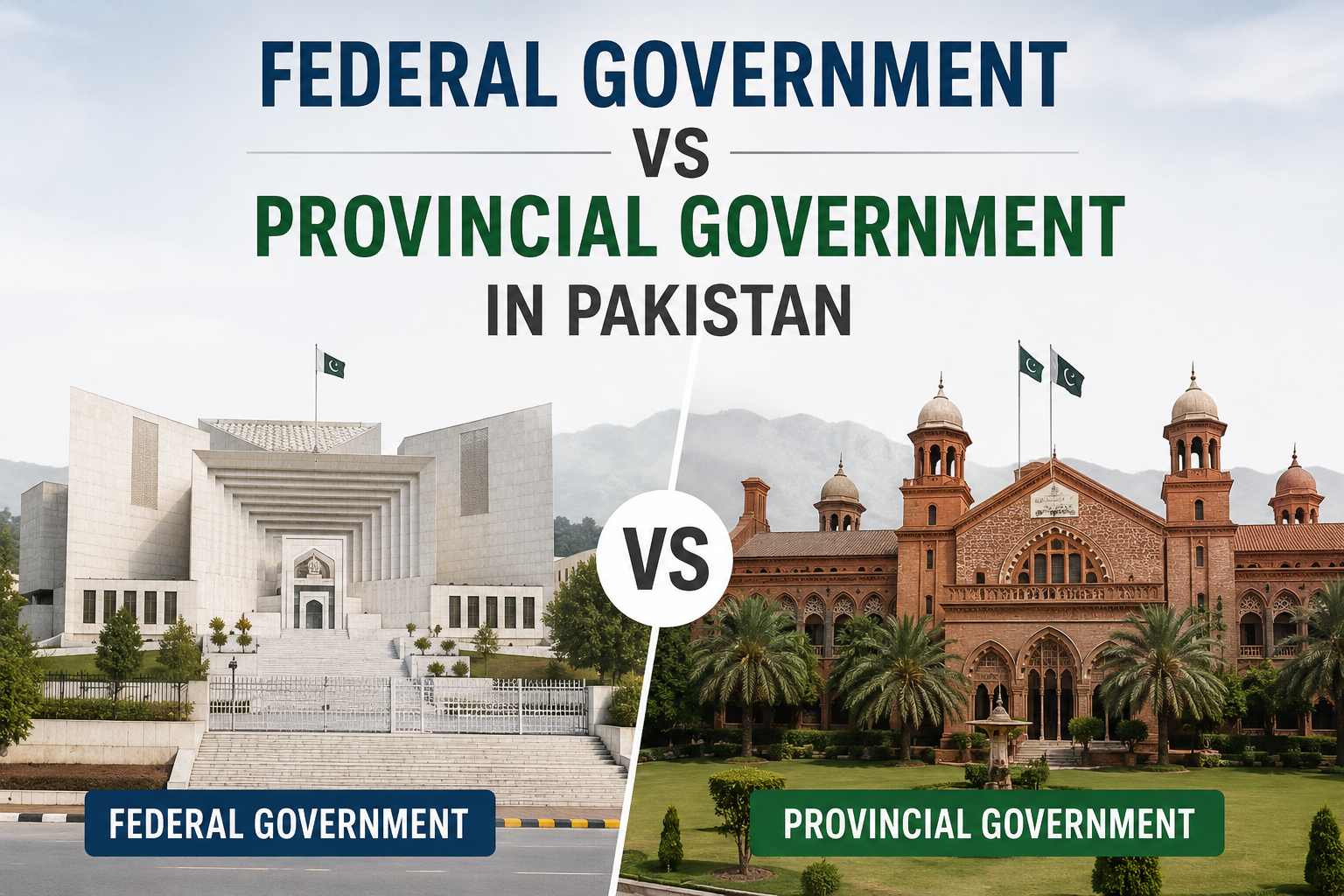
The Federal Government is the central government of Pakistan. It operates at the national level and deals with matters that affect the entire country. The Federal Government is based mainly in Islamabad and includes important institutions such as the Parliament, Prime Minister, federal ministries, and other national institutions.
The Prime Minister is the head of the Federal Government and leads the federal administration. Parliament consists of the National Assembly and the Senate. The President is the constitutional head of state.
The Federal Government is responsible for areas that require a national approach. For example, national defense, foreign policy, currency, federal taxation, citizenship, and international relations are mainly handled at the federal level.
When I think about the Federal Government, I see it as the government responsible for issues that cannot be effectively managed separately by each province. A country needs one common foreign policy, one national defense system, and a coordinated approach to many economic and national matters.
What Is a Provincial Government?
A Provincial Government operates within a particular province of Pakistan. Pakistan has four provinces, which are Punjab, Sindh, Khyber Pakhtunkhwa, and Balochistan. Each province has its own government, provincial assembly, Chief Minister, and provincial departments.
The Provincial Government focuses on matters that directly affect people within the province. Education, healthcare, agriculture, local development, and many areas of public administration are important responsibilities of provincial governments.
The Chief Minister leads the Provincial Government, while the Provincial Assembly makes provincial laws within the powers given to it by the Constitution.
In my opinion, provincial governments are especially important because they are closer to ordinary citizens. A provincial department can better understand local problems because it operates within the province and can design policies according to local needs.
Federal Government vs Provincial Government
The biggest difference between the Federal Government and Provincial Government is the level at which they operate.
The Federal Government works for the entire country, while a Provincial Government works for a particular province. The Federal Government deals with national and international matters, whereas Provincial Governments focus more on provincial matters and public services.
For example, foreign affairs are handled by the Federal Government because Pakistan needs one national foreign policy. Similarly, defense is a federal responsibility because national security requires a unified system.
On the other hand, many aspects of education and healthcare are managed at the provincial level. This allows provinces to create policies based on their own circumstances.
The division of powers is an important part of Pakistan’s federal system because it prevents every decision from being concentrated in one central authority.
Role of the Federal Government
The Federal Government has several major responsibilities. One of its most important responsibilities is national defense. Pakistan needs a coordinated defense system to protect its territory and national interests.
Foreign affairs are another major federal responsibility. Relations with other countries, international agreements, diplomatic missions, and international organizations require national coordination.
The Federal Government also plays a major role in monetary and economic matters. The national currency and many important areas of economic policy require federal administration.
Federal taxation is another important area. The Federal Government collects various taxes and uses national resources to finance federal programs and institutions.
The Federal Government also manages important national infrastructure and institutions. It develops policies that can affect the entire country and coordinates with provincial governments when national and provincial responsibilities overlap.
Role of Provincial Governments
Provincial Governments have a strong connection with public services. Education is one of the most visible areas where provincial governments play a major role.
Schools, colleges, teachers, curriculum implementation, and other educational matters are influenced by provincial policies and departments.
Healthcare is another major responsibility. Provincial health departments manage many public hospitals, healthcare programs, and medical services within their provinces.
Agriculture is also extremely important, particularly because Pakistan has a large agricultural sector. Provincial governments develop policies related to farming, irrigation support, agricultural development, and rural communities within their areas of responsibility.
Provincial governments also work on roads, development projects, public administration, and other services. Their decisions can have a direct impact on people’s everyday lives.
Why the 18th Amendment Matters
The 18th Amendment to the Constitution of Pakistan is very important when discussing Federal Government vs Provincial Government.
The amendment significantly strengthened provincial autonomy and transferred several responsibilities from the Federal Government to the provinces. One of the most important changes was the abolition of the Concurrent Legislative List.
This change gave provinces greater authority over various subjects and increased their role in areas such as education, health, and other public services.
From my perspective, the idea behind greater provincial autonomy is understandable. Pakistan is a large and diverse country, and the needs of Punjab may not always be the same as those of Balochistan, Sindh, or Khyber Pakhtunkhwa.
Giving provinces greater responsibility can allow them to develop policies that better reflect their local conditions.
Federal Government and Provincial Government Cooperation
Although the Federal Government and Provincial Governments have different responsibilities, they cannot work completely separately.
Many national issues require cooperation between both levels of government. Economic development, disaster management, public health, security, infrastructure, and environmental issues can involve federal and provincial institutions at the same time.
For example, if a natural disaster affects a province, the Provincial Government may handle immediate local administration while the Federal Government can provide additional resources, coordination, and national assistance.
Similarly, major development projects can require cooperation between federal institutions and provincial departments.
In my opinion, cooperation is one of the most important parts of successful federalism. Even if responsibilities are clearly divided, government performance can suffer when institutions do not communicate properly.
Difference in Lawmaking
Another important difference is lawmaking authority.
The Federal Parliament makes laws on subjects assigned to the Federal Government under the Constitution. Provincial Assemblies make laws on subjects that fall within provincial legislative authority.
This division allows both levels of government to perform their constitutional responsibilities.
However, constitutional matters and certain shared areas can sometimes require coordination between the two levels. This is why understanding the Constitution is important when discussing the powers of the Federal Government and Provincial Governments.
Difference in Revenue and Resources
Money is another important part of the relationship between the Federal Government and provinces.
The Federal Government collects major sources of national revenue and distributes resources through constitutional mechanisms. The National Finance Commission is particularly important because it deals with the distribution of certain financial resources between the federation and provinces.
Provincial governments also have their own sources of revenue and financial responsibilities.
The distribution of resources can sometimes become a subject of political debate because provinces have different populations, economic conditions, geographic challenges, and development requirements.
A fair financial system is important because provinces need sufficient resources to provide quality public services.
Which Government Is More Important?
I do not think it is useful to say that the Federal Government is more important than the Provincial Government, or vice versa. Both have different constitutional responsibilities.
The Federal Government is essential for national matters such as defense, foreign affairs, currency, and national economic coordination.
Provincial Governments are essential for many services that people experience directly, including education, healthcare, agriculture, and provincial development.
A strong country needs both levels to perform their responsibilities effectively.
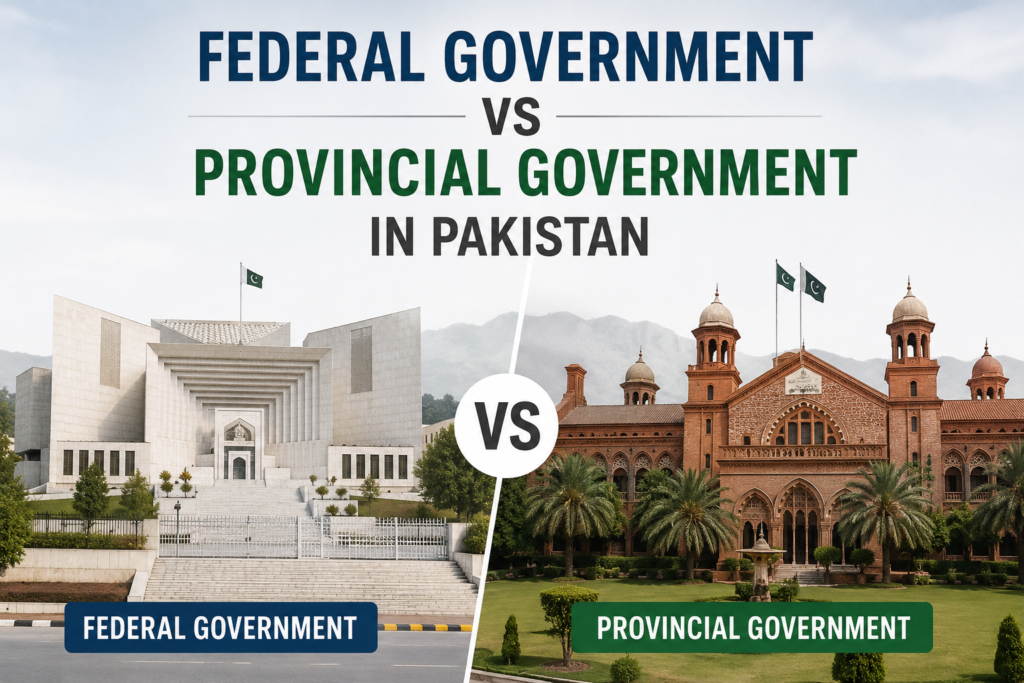
Federal Government vs Provincial Government in Daily Life
Many people may not realize how both levels of government affect their everyday lives.
When we think about national security, passports, foreign relations, and federal taxation, we are dealing with areas connected to the Federal Government.
When we think about public schools, provincial hospitals, agriculture programs, and many local development services, provincial institutions become more relevant.
This is why citizens should understand which government is responsible for a particular issue. Knowing the correct authority can make it easier to raise complaints, seek information, or understand government decisions.
Challenges in the Federal System
Pakistan’s federal system also faces challenges. One major challenge is coordination between federal and provincial institutions.
Sometimes responsibilities can overlap or different levels of government may have different priorities. Political disagreements can also affect cooperation.
Another challenge is the unequal availability of resources. Provinces have different population sizes, economic conditions, and geographical requirements.
Administrative capacity is another important issue. Giving a government responsibility is not enough if it does not have the resources, trained staff, institutions, and planning capacity needed to perform that responsibility effectively.
In my opinion, Pakistan can improve its federal system by focusing more on cooperation, transparency, accountability, and better public service delivery.
Conclusion
The difference between the Federal Government and Provincial Government in Pakistan is mainly based on their constitutional responsibilities and the level at which they operate.
The Federal Government works at the national level and handles major matters such as defense, foreign affairs, currency, and federal economic responsibilities. Provincial Governments work within their respective provinces and have major responsibilities related to education, healthcare, agriculture, and provincial administration.
I believe both levels of government are necessary for Pakistan to function effectively. The Federal Government provides national coordination, while Provincial Governments can respond to issues that are closer to local communities.
The real strength of Pakistan’s federal system depends not only on dividing powers but also on using those powers responsibly. When the Federal Government and Provincial Governments cooperate, respect constitutional boundaries, manage resources properly, and focus on citizens, the entire country can benefit.
For ordinary citizens, understanding the Federal Government vs Provincial Government difference is useful because it helps us understand how Pakistan’s political system works and who is responsible for different public services. A better understanding of government can also encourage people to become more informed and responsible citizens.