When we talk about the Parliament of Pakistan, most people immediately think about the National Assembly. However, Pakistan has another very important parliamentary house called the Senate. In my view, understanding the Senate of Pakistan is important because it has a unique role in protecting the interests of the provinces and maintaining balance within the federal system.
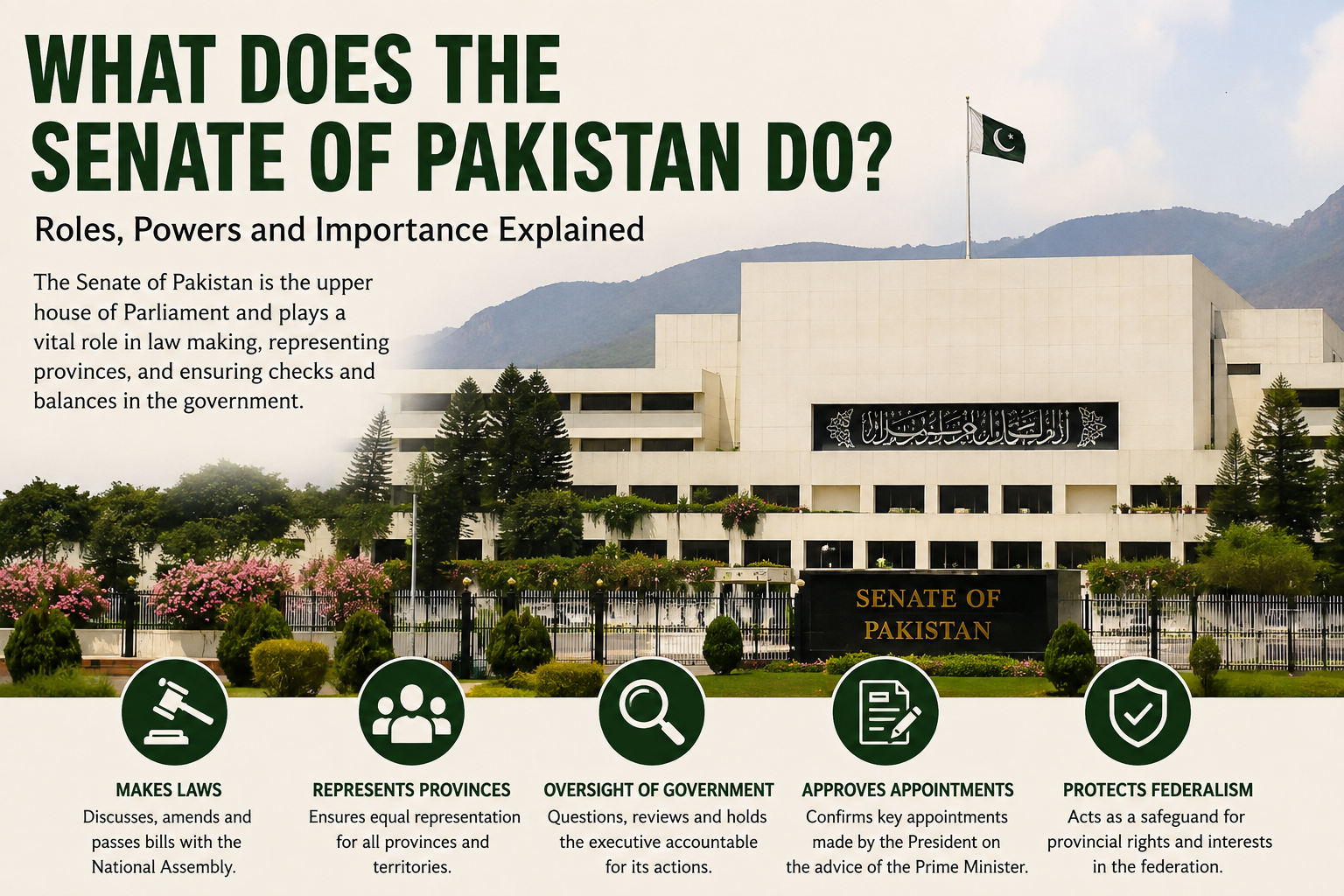
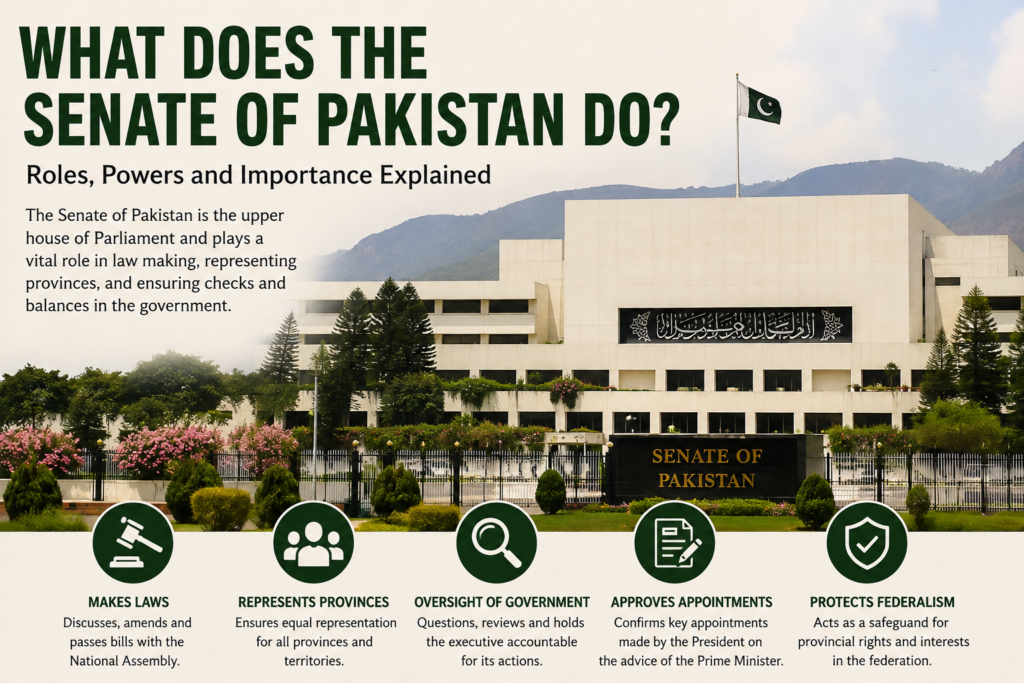
The Senate of Pakistan is the upper house of Parliament. Its main purpose is to provide equal representation to the provinces and give them an important voice in national decision making. Unlike the National Assembly, where representation is mainly based on population, the Senate gives equal representation to the provinces. This makes it an important part of Pakistan’s democratic and federal structure.
In this article, I will explain what the Senate of Pakistan does, how it works, what powers it has, and why it is important for the country.
What Is the Senate of Pakistan?
The Senate of Pakistan is the upper house of the Parliament of Pakistan. It was created under the Constitution of Pakistan to provide representation to the federating units and to strengthen the federal system.
The Senate is a permanent house. This means that it is not dissolved in the same way as the National Assembly. Members of the Senate serve fixed terms, and elections are held for a portion of the seats at different times. This system provides continuity in parliamentary affairs.
One thing I find particularly important about the Senate is that it gives smaller provinces a stronger voice at the federal level. If representation were based only on population, larger provinces would naturally have more seats. The Senate helps create a balance by providing equal provincial representation.
How Is the Senate Different From the National Assembly?
The Senate and National Assembly are both parts of Parliament, but they have different roles and methods of representation.
The National Assembly represents the people mainly according to population. A province with a larger population has more seats in the National Assembly.
The Senate works differently. Its structure is designed to represent the provinces and other federally represented areas rather than simply reflecting population size.
This difference is important because Pakistan is a federation. The federal government must consider both the population of the country and the interests of its provinces.
In simple words, I would describe the National Assembly as a house that strongly represents the people according to population, while the Senate provides a stronger institutional voice for the provinces.
Representation of the Provinces
One of the most important functions of the Senate of Pakistan is representing the provinces.
Pakistan has four provinces, and the Senate gives them equal representation in its provincial component. This means that a smaller province can have an important voice in the upper house even though its population is smaller than that of a larger province.
This arrangement is important for federalism. It helps prevent the national political system from becoming completely dominated by population size.
From my point of view, this is one of the strongest reasons why the Senate matters. Pakistan has different provinces with different geographical, economic, and social conditions. Giving them a meaningful voice at the federal level can help make national decisions more balanced.
Role of the Senate in Making Laws
Another major responsibility of the Senate is participating in the law making process.
When bills are introduced in Parliament, the Senate can discuss, examine, debate, amend, and pass legislation according to the constitutional procedure.
Senators can debate proposed laws and raise concerns about how a bill might affect the country or the provinces. Parliamentary committees also play an important role by examining bills and government policies in greater detail.
The law making process is important because legislation can affect millions of people. A detailed discussion in Parliament can help identify weaknesses, practical problems, and possible improvements.
The Senate therefore acts as an important part of the legislative process.
Senate Committees
A large amount of parliamentary work happens through committees.
Senate committees examine government departments, proposed legislation, policies, budgets, and other matters related to their assigned areas.
Committees allow senators to study issues in more detail than may be possible during a general parliamentary sitting. They can ask questions, request information, examine government performance, and prepare reports.
In my opinion, committees are one of the most useful parts of Parliament because serious parliamentary oversight requires detailed examination. A short speech in the Senate may attract attention, but committee work can involve much deeper investigation.
Checking the Government
The Senate also contributes to parliamentary oversight of the executive branch of government.
Senators can ask questions, raise issues, discuss government policies, and seek explanations from government representatives. Through debates and committee proceedings, the Senate can examine how government departments are functioning.
This oversight is important in a democracy because government institutions should be accountable for their decisions and actions.
The Senate does not run government departments itself. Instead, it performs a checking and questioning role within the parliamentary system.
I believe this function is particularly important because democracy is not only about elections. It is also about accountability, transparency, and responsible decision making after elections.
Discussion of National Issues
The Senate provides a platform where important national issues can be discussed.
Senators may raise subjects related to the economy, education, healthcare, security, agriculture, technology, provincial development, infrastructure, foreign affairs, and many other areas.
Because senators represent provinces and other constituencies within the federal structure, debates can bring different regional perspectives into national discussions.
For example, an issue that seems beneficial from a national perspective may create different challenges for a particular province. Senate debates can provide an opportunity for these concerns to be heard.
This makes the Senate an important forum for discussion rather than simply a place where laws are voted on.
Constitutional Amendments
The Senate also has an important role when Parliament considers constitutional amendments.
The Constitution is the foundation of Pakistan’s legal and political system. Changes to it can have long term consequences for the country.
Constitutional amendments require approval through the parliamentary process established by the Constitution. The Senate therefore becomes an important part of discussions about major constitutional changes.
This role makes the Senate especially significant because constitutional matters can directly affect the relationship between the federal government and provinces.
Role in the Federal System
Pakistan follows a federal system in which powers and responsibilities are divided between the federal government and the provinces.
The Senate supports this federal structure by giving the provinces a strong voice in Parliament.
I think this role is easy to overlook, but it is extremely important. A federation works best when different regions believe that their interests are being considered.
The Senate can help strengthen that sense of participation by ensuring that provinces have institutional representation at the national level.
Who Elects the Senators?
Senators are not elected in the same way as members of the National Assembly.
Members of the Senate are elected through the relevant provincial assemblies and other electoral arrangements provided by the Constitution. The Senate therefore has an indirect election system.
This is different from the direct election of National Assembly members by voters in general elections.
The Senate’s electoral structure is designed to represent the federal units and maintain continuity in the upper house.
The Chairman of the Senate
The Senate is headed by the Chairman of the Senate.
The Chairman presides over Senate proceedings and helps maintain order during parliamentary sessions. The office is constitutionally significant and plays an important role in the functioning of the upper house.
The Chairman does not act as the head of government. Instead, the position is connected with managing and presiding over Senate business.
The Deputy Chairman assists the Chairman and can perform the Chairman’s responsibilities when required.
The Senate and the Budget
One important distinction between the Senate and National Assembly concerns money bills.
Under Pakistan’s constitutional system, the National Assembly has the primary role regarding money bills. The Senate can consider financial matters and provide recommendations within the constitutional framework, but it does not have exactly the same powers as the National Assembly over money bills.
This difference exists because the National Assembly is directly elected by the people and has a central constitutional role in financial legislation.
Understanding this distinction helps explain why the two houses have different responsibilities even though both are part of Parliament.
Why Is the Senate Important?
In my opinion, the Senate is important because it provides balance.
Pakistan is a large and diverse country. Its provinces have different populations, resources, geographical conditions, and development priorities.
A parliamentary system based only on population could make the interests of smaller provinces less influential. The Senate helps address this issue by providing provincial representation in the upper house.
It also provides continuity because the Senate is a permanent house. This means parliamentary representation continues even when the National Assembly is dissolved.
The Senate therefore contributes to stability, provincial participation, law making, and government oversight.
Senate and Democracy in Pakistan
Democracy requires more than voting every few years. It requires institutions where people and regions can participate in decision making.
The Senate is one of those institutions.
Through debates, committees, legislation, questions, and oversight, senators participate in the national political process. Their work can influence laws and government policies.
For ordinary citizens, the Senate may sometimes seem distant from daily life. However, the laws and policies discussed in Parliament can affect education, employment, taxation, business, public services, provincial development, and many other areas.
That is why learning about the Senate of Pakistan can help people better understand how the country’s government works.
Final Thoughts
The Senate of Pakistan is an important part of the country’s Parliament and federal structure. Its main purpose is to provide provincial representation, participate in law making, examine government performance, discuss national issues, and contribute to the constitutional and democratic process.
What makes the Senate special is its role in balancing representation. The National Assembly mainly reflects population, while the Senate gives the provinces an important and more equal voice at the federal level.
From my perspective, the Senate should be understood not simply as another parliamentary chamber, but as an institution designed to strengthen federalism and provide continuity in Pakistan’s political system.
When we understand what the Senate of Pakistan does, we also get a better understanding of how Parliament works, how laws are made, and how the interests of different parts of the country can be represented at the national level.
A strong parliamentary system depends on informed debate, responsible legislation, accountability, and meaningful representation. The Senate plays a valuable role in all of these areas and remains an important institution in the democratic structure of Pakistan.