When I think about how Pakistan is governed, one of the most important institutions that comes to mind is the National Assembly of Pakistan. It is a central part of the country’s parliamentary system and plays a major role in making laws, discussing national issues, approving the federal budget, and holding the government accountable. For an ordinary citizen, understanding what the National Assembly does can make it much easier to understand how important national decisions are made.
The National Assembly is the lower house of the Parliament of Pakistan. The Parliament also includes the Senate. While both houses have important responsibilities, the National Assembly has a particularly important role in matters related to elected representation, legislation, and financial affairs.
In my view, the National Assembly is important because it provides a formal platform where representatives elected by the people can discuss the problems and priorities of the country.
What Is the National Assembly of Pakistan?
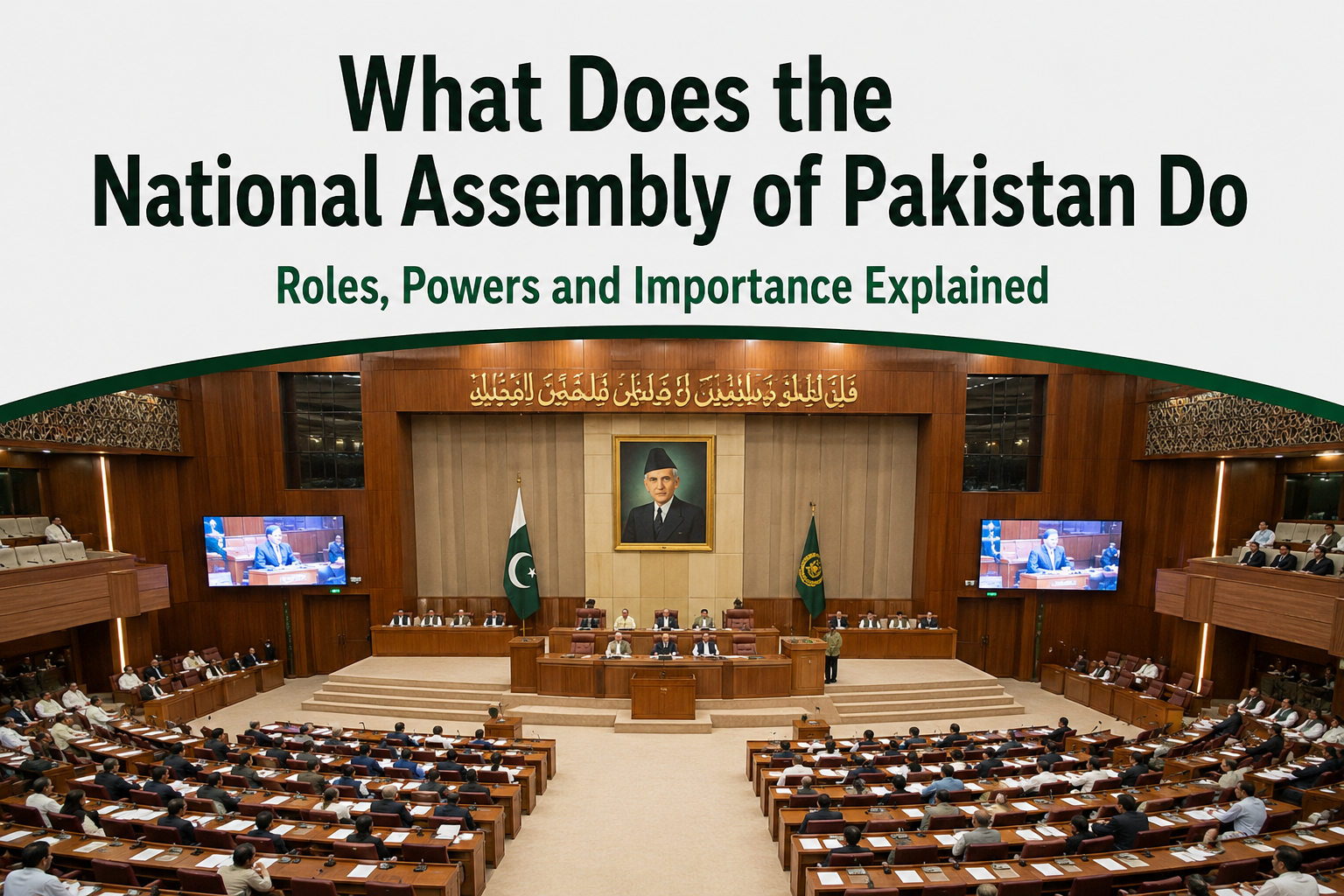
The National Assembly of Pakistan is the directly elected house of Parliament. Its members are known as Members of the National Assembly, commonly called MNAs. Citizens vote for representatives during general elections, and those representatives become members of the National Assembly according to the constitutional and electoral system.
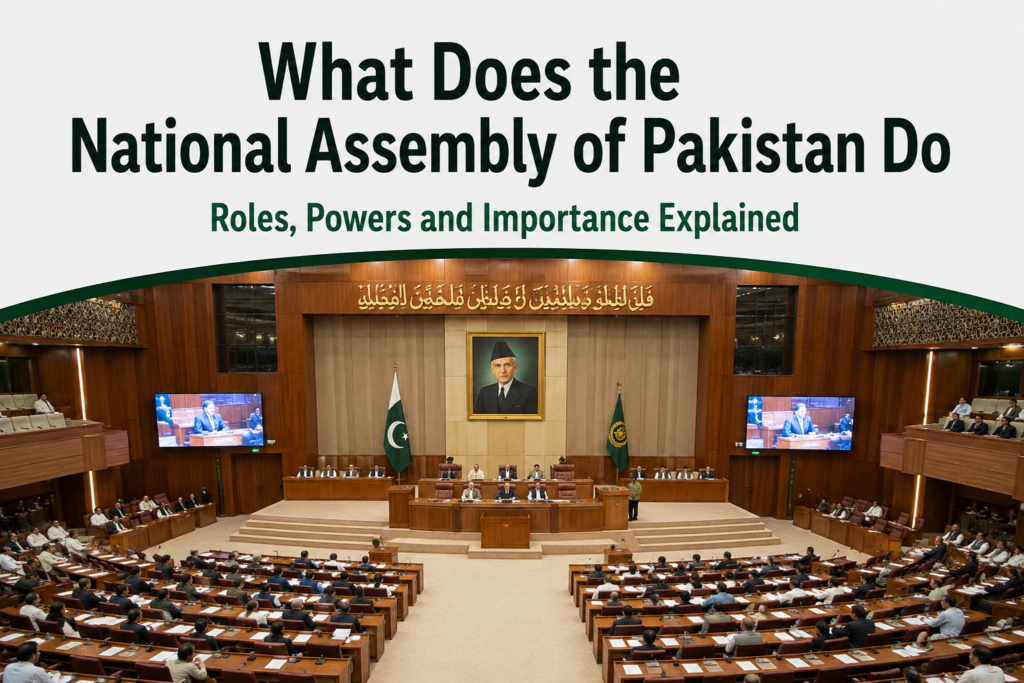
The National Assembly meets in Islamabad, where members debate proposed laws, government policies, public problems, and matters of national importance.
The Constitution of Pakistan gives the National Assembly several important responsibilities. These responsibilities are not limited to passing laws. The assembly also has an important role in overseeing the federal government and approving public spending.
Making Laws for Pakistan
One of the main functions of the National Assembly is legislation. In simple words, the National Assembly discusses and passes laws that are needed to regulate different areas of national life.
A proposed law is generally introduced as a bill. Members discuss the bill, examine its provisions, and may suggest changes. Parliamentary committees can also examine bills in greater detail before the legislation moves through the required parliamentary process.
For me, this is one of the most important responsibilities of the National Assembly because laws affect almost every part of daily life. Laws can relate to education, business, taxation, public administration, technology, employment, national security, and many other areas.
However, legislation is not simply about one person making a decision. Parliamentary discussion allows elected representatives from different political parties and regions to present their views.
Representing the People
Another major role of the National Assembly is representation.
Pakistan is a large and diverse country with different provinces, districts, communities, and political interests. The National Assembly gives elected representatives an opportunity to bring issues from their constituencies to the federal level.
An MNA may raise concerns about roads, education, healthcare, employment, development projects, electricity, water, or other issues affecting citizens.
I believe this representative function is particularly important because democracy is not only about voting during elections. People also need representatives who can raise their concerns after elections.
The National Assembly creates a formal place where these concerns can become part of national political discussion.
Electing the Prime Minister
The National Assembly also has an important constitutional role in the election of the Prime Minister.
The Prime Minister is the head of the federal government and is elected by the National Assembly from among its members. Usually, the leader who can command the confidence of the majority in the National Assembly is in the strongest position to form the federal government.
This makes the National Assembly closely connected with the functioning of the federal executive.
The Prime Minister and federal government must maintain the confidence of the National Assembly. This is an important feature of Pakistan’s parliamentary system because the government is expected to remain accountable to the elected house.
Approving the Federal Budget
Money and public spending are another major area where the National Assembly has significant authority.
Every year, the federal government presents its budget to Parliament. The budget explains how the government plans to collect revenue and spend public money during the financial year.
The National Assembly examines the financial proposals and plays a central role in approving federal expenditure.
This responsibility matters because government money ultimately comes from public resources. Parliament provides a mechanism through which elected representatives can examine how those resources are planned to be used.
In my opinion, the budget process is one of the areas where parliamentary oversight becomes especially important. Decisions about taxes, development spending, government programs, and public services can have a direct impact on ordinary people.
Holding the Government Accountable
The National Assembly does not simply support the government. It also provides a mechanism for questioning and examining government performance.
Members can ask questions about government departments and policies. They can participate in debates and raise issues that require attention from federal ministers.
Opposition members have an especially important role in this process. They can criticize government decisions, identify problems, and demand explanations.
Parliamentary questions and debates can therefore help bring government activities into public discussion.
A strong parliament should not only pass laws. It should also make sure that the government explains its decisions and remains accountable for its performance.
Debating National Issues
The National Assembly is also a place for debate.
Pakistan faces many complex issues, including economic development, unemployment, education, healthcare, security, climate change, population growth, energy, and international relations.
Not every issue can be solved immediately through legislation. Sometimes parliamentarians need to debate an issue, present different perspectives, and encourage the government to take action.
These debates can also help citizens understand the positions of different political parties.
From my perspective, healthy parliamentary debate is valuable because different opinions are a normal part of democracy. The important thing is that debate should focus on national interests and public concerns.
Parliamentary Committees
A significant amount of parliamentary work takes place through committees.
National Assembly committees examine bills, government policies, departmental matters, and other subjects within their areas of responsibility. Committees can study issues in greater detail than is usually possible during a general session of the house.
This makes committees an important part of parliamentary oversight.
For example, a committee dealing with a particular ministry or subject can examine relevant government activities and ask officials for information.
I think committees are especially useful because detailed examination requires time and attention. Parliamentary sessions can involve many political issues, while committees provide an opportunity for more focused work.
Constitutional Responsibilities
The National Assembly also has responsibilities connected with the Constitution of Pakistan.
Certain constitutional amendments require parliamentary approval through the procedure established by the Constitution. This gives Parliament an important role in shaping the country’s constitutional framework.
However, constitutional change is different from ordinary legislation and requires special procedures and levels of approval.
The constitutional role of Parliament shows that the National Assembly is not simply an institution for everyday political debate. It is also part of the system through which Pakistan’s constitutional and democratic structure operates.
Role During a Vote of No Confidence
The National Assembly can also play an important role when the political survival of a government becomes an issue.
A vote of no confidence against the Prime Minister is a constitutional parliamentary process. Members of the National Assembly vote on whether the Prime Minister continues to command the confidence of the house.
This is an important feature of a parliamentary system because it provides a constitutional method for determining whether a government still has the support required to remain in office.
National Assembly and Democracy
The National Assembly is closely connected with the democratic system of Pakistan.
Through elections, citizens choose representatives. Those representatives participate in Parliament and take part in legislation, debates, financial decisions, and government oversight.
Of course, the effectiveness of any parliament depends on how responsibly its members perform their duties. A parliament can only serve the public effectively when representatives take legislation seriously, participate in debates, examine government performance, and consider the interests of citizens.
In my opinion, democracy becomes stronger when people understand these institutions rather than viewing politics only through political parties or election campaigns.
Difference Between the National Assembly and Senate
Many people confuse the National Assembly with the Senate, but they have different roles within Parliament.
The National Assembly is the directly elected house, while the Senate represents the provinces and other federal units through its constitutional structure.
The National Assembly has a particularly important role in financial matters and in determining who can form the federal government.
The Senate, on the other hand, provides representation of the federating units and serves as a continuing house because its members have staggered terms.
Both houses are important for the functioning of Parliament, but their constitutional roles are not identical.
Why the National Assembly Matters to Ordinary Citizens
Someone might ask why an ordinary citizen should care about the National Assembly.
The answer is simple. Decisions made at the federal level can affect everyday life.
Federal laws, taxation, national policies, public spending, economic decisions, and government programs can influence employment, businesses, education, infrastructure, and public services.
The National Assembly provides a channel through which citizens’ elected representatives can participate in these decisions.
That is why I believe understanding the National Assembly is not only useful for students of politics. It is useful for anyone who wants to understand how Pakistan works.
Final Thoughts
The National Assembly of Pakistan performs several important functions. It makes and discusses laws, represents citizens, elects the Prime Minister, examines government policies, approves federal financial matters, debates national issues, and provides a mechanism for holding the federal government accountable.
In my view, its greatest importance comes from its connection with democratic representation. Members of the National Assembly are expected to represent people and participate in decisions that affect the country as a whole.
Understanding what the National Assembly of Pakistan does helps us understand the broader political system of the country. It also reminds us that democracy is not limited to elections. It involves representation, legislation, debate, accountability, and responsible decision making.
For citizens, learning about Parliament is a useful step toward becoming more informed about national affairs. When people understand how institutions work, they can better evaluate political decisions and ask meaningful questions about the future of Pakistan.