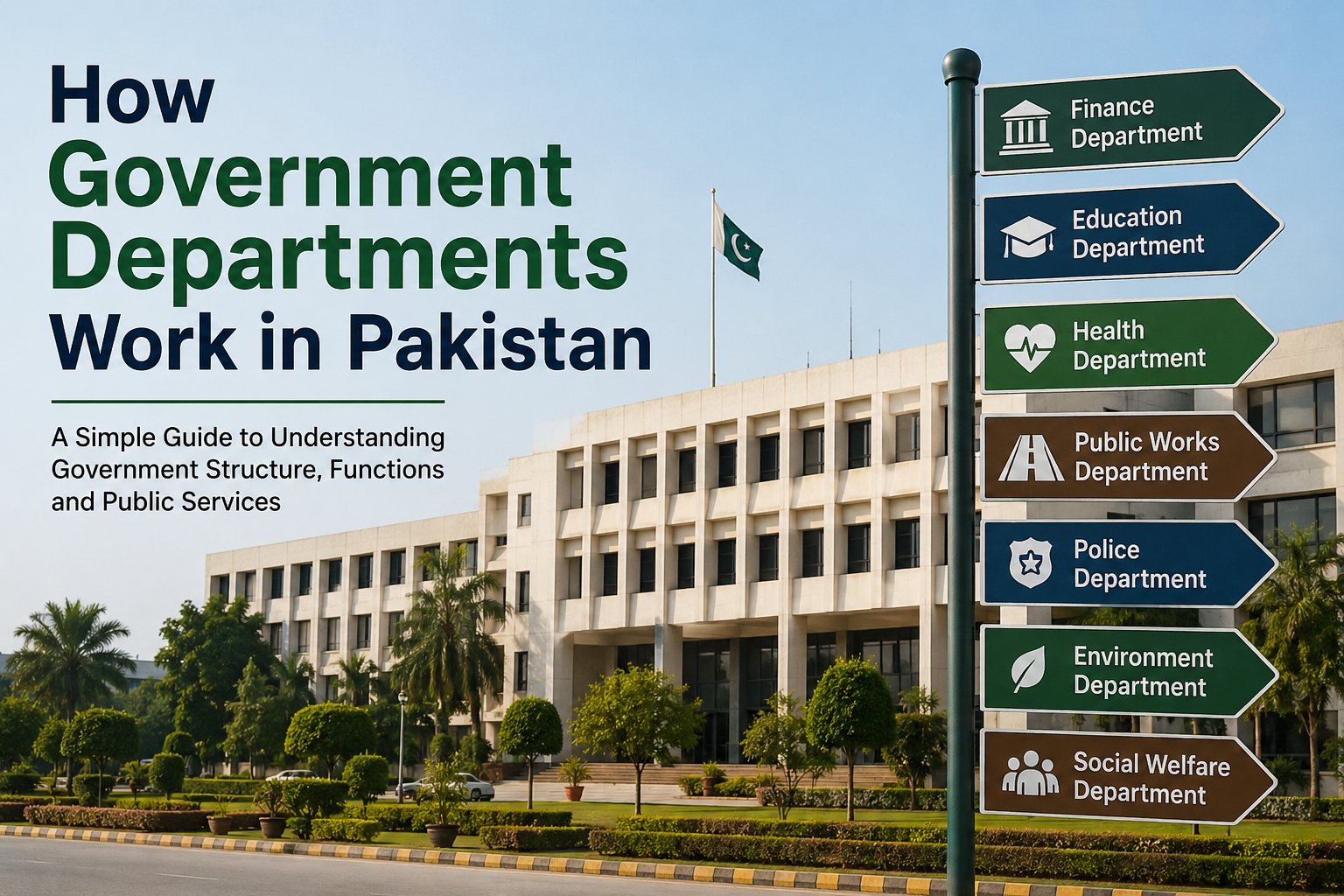
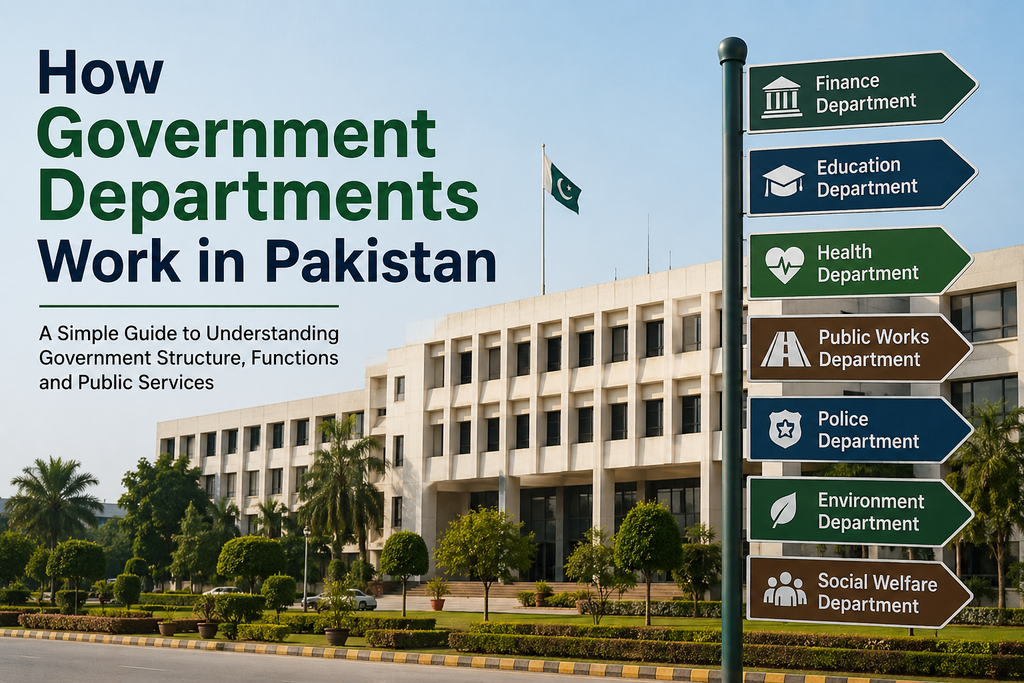
When we talk about the government of Pakistan, many people imagine Parliament, ministers, or the Prime Minister. However, the government is much larger than these institutions. Behind almost every public service is a government department or organization working at the federal, provincial, or local level.
In my view, understanding how government departments work in Pakistan is important for every citizen. It helps us understand where decisions are made, who is responsible for public services, and where we should go when we need government assistance.
The government system can sometimes look complicated because Pakistan has different levels of government and many departments with different responsibilities. Once we understand the basic structure, however, it becomes much easier to follow.
What Is a Government Department?
A government department is an official public institution responsible for a particular area of government work. Each department has specific duties, rules, employees, and administrative responsibilities.
For example, the education department deals with public education matters, while the health department works on public health services. Similarly, finance departments manage important financial matters, and agriculture departments deal with farming and agricultural development.
Government departments do not normally operate independently. They work under laws, policies, rules, budgets, and administrative instructions established through the appropriate government authorities.
The Three Main Levels of Government in Pakistan
One of the easiest ways to understand government departments in Pakistan is to divide them into three major levels.
These are the federal government, provincial governments, and local governments.
The federal government handles matters that are national in nature. Provincial governments manage many subjects within their provinces. Local governments are responsible for services and administration closer to ordinary citizens.
Each level has its own responsibilities, although their functions can sometimes interact.
Federal Government Departments
The federal government operates at the national level. It deals with subjects that affect the country as a whole.
Federal ministries and divisions are important parts of this system. They are responsible for developing policies, implementing laws, managing national programs, and coordinating important government activities.
Some major areas handled at the federal level include foreign affairs, defence, national economic policy, taxation in areas assigned to the federation, and other matters listed under the constitutional framework.
A federal ministry is generally headed politically by a minister, while senior civil servants provide administrative support and help implement government policies.
For example, a minister may provide political direction, while the bureaucracy handles much of the day to day administrative work.
Provincial Government Departments
Pakistan has four provinces, and each provincial government has its own departments.
Provincial departments deal with many services that directly affect people’s daily lives. These can include education, health, agriculture, local government, communication and works, revenue, and other areas assigned to provincial governments.
The Chief Minister leads the provincial government politically, while provincial ministers oversee different departments.
Civil servants and other government employees then help implement policies, manage offices, prepare records, deliver services, and carry out administrative decisions.
This division is important because a person looking for a public service may need to approach a provincial department rather than a federal ministry.
Local Government
Local government is the level of administration closest to ordinary citizens.
Depending on the applicable provincial laws and administrative arrangements, local government institutions can deal with services such as sanitation, waste management, local roads, municipal services, community facilities, and other local matters.
The exact structure of local government can vary because provinces establish their local government systems under relevant laws.
For citizens, local government can be especially important because many everyday issues are connected to municipal and community services.
Who Controls a Government Department?
A government department normally has both political and administrative leadership.
The political leadership generally includes the relevant minister or other elected authority. Political leaders are responsible for policy direction and represent the government before Parliament or the relevant provincial assembly.
The administrative side is generally managed by civil servants and other officials.
Senior officials help translate policies into administrative actions. They prepare summaries, maintain records, supervise staff, manage programs, and coordinate with other departments.
This means that a government department is not simply controlled by one person. Different officials have different responsibilities according to the law and administrative rules.
How Policies Become Government Actions
A useful way to understand how the government works in Pakistan is to look at the general policy process.
First, the government identifies an issue or priority. It could be related to education, health, economic development, infrastructure, public safety, or another area.
Officials may then study the issue and prepare proposals. Different departments can provide information, financial estimates, legal opinions, and administrative recommendations.
The relevant political leadership considers the proposal. Where necessary, approval may be required from the cabinet, legislature, or another competent authority.
After approval, the responsible department works on implementation.
This process can involve issuing rules, allocating funds, appointing staff, purchasing equipment, launching programs, or coordinating with provincial and local authorities.
The exact process depends on the nature of the decision and the legal authority involved.
How Government Budgets Work
Money is one of the most important parts of government administration.
Every department needs financial resources to operate. Government budgets provide funding for salaries, infrastructure, public programs, equipment, development projects, and other expenses.
At the federal and provincial levels, budgets are presented through established constitutional and legislative procedures.
A department generally cannot spend public money simply because it wants to. Government spending is subject to financial rules, approved allocations, and relevant legal procedures.
This is why the finance department or finance division plays an important role in government administration.
Role of Civil Servants
Civil servants are an important part of the government system.
While elected politicians change after elections or political developments, many government employees continue working within the administrative system.
Their responsibilities can include preparing official documents, implementing policies, managing public offices, maintaining records, supervising projects, responding to applications, and advising political leadership on administrative matters.
In my opinion, this distinction between political leadership and permanent administration is one of the most important things to understand when learning about government departments in Pakistan.
Politicians generally provide political direction, while civil servants provide administrative continuity and expertise.
How Citizens Interact With Government Departments
Ordinary citizens interact with government departments in many ways.
Someone may visit an education office regarding a school matter. Another person may approach a revenue office regarding land records. A business owner may need government approval or registration. A family may contact a health department or public hospital for services.
The correct office depends on the issue.
This is why identifying the responsible department is often the first step.
Citizens should also keep copies of applications, receipts, reference numbers, and official correspondence whenever possible. Maintaining proper records can make it easier to follow up on an application.
Why Government Departments Sometimes Seem Complicated
Many people find government offices difficult to understand because several institutions can be involved in one issue.
For example, a public project might involve a department that develops the policy, another department that provides funding, an administrative authority that implements the project, and a local institution that manages services on the ground.
There can also be different rules at federal and provincial levels.
For this reason, understanding the difference between federal, provincial, and local responsibilities can save time and confusion.
Accountability and Oversight
Government departments are expected to operate according to the Constitution, laws, rules, and applicable administrative procedures.
There are different mechanisms for accountability and oversight. Parliament and provincial assemblies can examine government activities. Audit institutions examine public finances. Courts can review government actions in appropriate cases.
Other oversight bodies and complaint mechanisms may also play a role depending on the issue.
Accountability is important because government departments deal with public money, public authority, and services that affect millions of people.
Why Understanding Government Departments Matters
I believe citizens should have at least a basic understanding of government departments because government decisions affect everyday life.
Knowing which department handles a particular matter can help people submit applications correctly, understand official decisions, follow public policies, and communicate more effectively with government offices.
It also helps people become more informed citizens.
Instead of simply hearing that the government has made a decision, we can ask more useful questions. Which department is responsible? What law applies? Which level of government has authority? What procedure should citizens follow?
These questions can lead to a much better understanding of public administration.
Final Thoughts
Understanding how government departments work in Pakistan does not require a degree in political science or public administration. The basic idea is relatively simple.
Pakistan has different levels of government, including federal, provincial, and local institutions. Each department has specific responsibilities. Political leaders provide direction, while civil servants and other government employees carry out much of the administrative work.
Government departments operate through laws, policies, budgets, rules, and established procedures. Citizens interact with these departments whenever they need public services, approvals, records, information, or other forms of government assistance.
From my point of view, learning about government departments is one of the best ways to understand how Pakistan’s public administration actually functions. Once we know which institution is responsible for a particular matter, the entire government system becomes easier to understand.
This basic knowledge can help citizens deal with government offices more confidently and become more aware of their rights, responsibilities, and available public services.