The Prime Minister of Pakistan is one of the most important political positions in the country. When people watch general elections, they often think that voters directly choose the Prime Minister. In reality, the process works differently. Pakistani voters elect members of the National Assembly, and those elected members then choose the Prime Minister.
In my view, understanding this process is important because it helps us understand how parliamentary democracy works in Pakistan. The Prime Minister is not elected through a separate nationwide vote. Instead, the person who can secure the support of the majority of the National Assembly becomes the central figure in forming the federal government.
This article explains how a Prime Minister is chosen in Pakistan, what role political parties play, how voting takes place in the National Assembly, and what happens after the election.
How the Parliamentary System Works in Pakistan
Pakistan follows a parliamentary form of government. Under this system, the Prime Minister is the head of the federal government, while the President is the head of state.
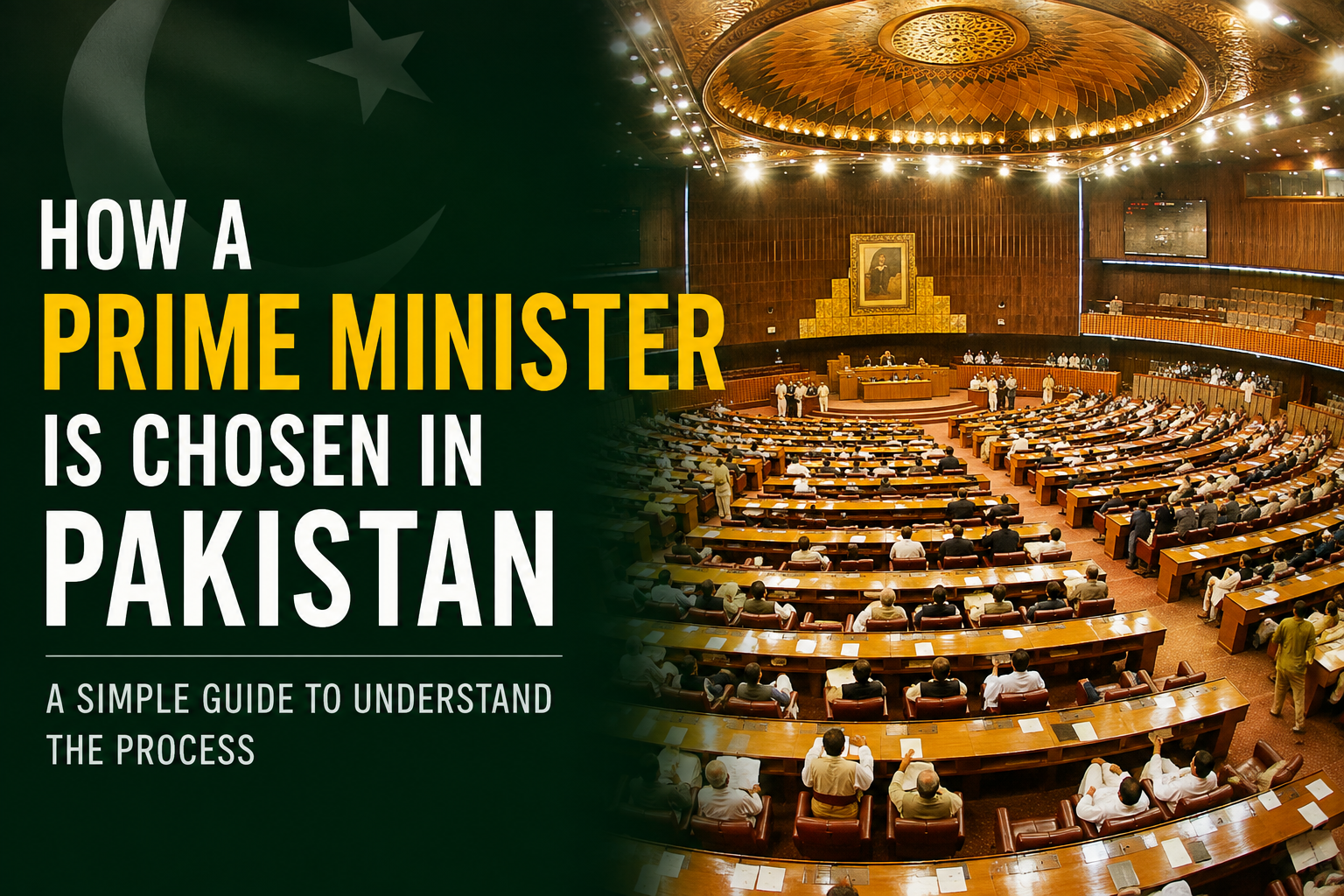
The National Assembly plays a central role in choosing the Prime Minister. General elections are held to elect members of the National Assembly. These members represent different constituencies across Pakistan.
After the election results are announced, political parties look at the number of seats they have won. A party that has enough seats to command a majority has a strong position to form the federal government.
Sometimes one political party wins enough seats to form the government on its own. In other situations, no party has enough seats by itself. When that happens, parties may work together and form a coalition government.
This is one of the most interesting parts of the Pakistani political system because the ability to form a government depends heavily on parliamentary support.
Who Can Become Prime Minister of Pakistan?
The Constitution of Pakistan sets certain requirements for becoming Prime Minister.
The Prime Minister is elected from among the Muslim members of the National Assembly. The person must also be eligible to be a member of the National Assembly under the Constitution.
This means that an individual cannot simply announce that they want to become Prime Minister and take the position. They need to be a member of the National Assembly and must receive the required support from other members.
Political parties usually nominate one of their senior leaders for the position. The person chosen by a party is normally someone who has strong political support and is considered capable of leading the parliamentary group.
The Role of General Elections
General elections are the starting point of the process.
During a general election, citizens vote for candidates competing for seats in the National Assembly. They are not directly voting for the Prime Minister.
For example, if a voter supports a particular political party, they normally vote for the party candidate contesting the National Assembly seat in their constituency.
After voting is completed, the Election Commission of Pakistan announces the results. The number of seats won by each party becomes extremely important because those numbers determine the balance of power in the National Assembly.
From my point of view, this is where the connection between voters and the Prime Minister becomes clear. People elect representatives, and those representatives participate in choosing the government.
Majority Support in the National Assembly
The most important factor in choosing a Prime Minister is majority support in the National Assembly.
The Constitution provides a specific procedure for the election of the Prime Minister. After the National Assembly has been formed, members choose the Prime Minister through a vote.
A candidate needs to secure a majority of the total membership of the National Assembly in the first round.
If no candidate receives the required majority in the first voting, another vote can take place between the candidates who receive the highest numbers of votes according to the constitutional procedure.
In the second stage, the candidate who receives the majority of votes of the members present and voting can be elected.
This procedure ensures that the Prime Minister has parliamentary support rather than simply being selected by one political party without consideration of the National Assembly.
How Political Parties Choose Their Candidate
Political parties have an important role before the National Assembly election for Prime Minister.
Usually, the party with the strongest parliamentary position selects its leader or another senior member as its candidate for Prime Minister.
The party leadership discusses its strategy and counts the support it expects to receive from members of the National Assembly.
In a coalition government, the situation can become more complicated. A party may not have enough seats to elect its candidate alone. It may therefore negotiate with other parties.
Coalition partners may agree to support a particular candidate for Prime Minister. These agreements can be based on political cooperation, government responsibilities, and other parliamentary arrangements.
This is why the number of seats held by each political party matters so much after a general election.
The Election of the Prime Minister
Once the National Assembly is ready to elect the Prime Minister, the Speaker conducts the proceedings according to the constitutional procedure and parliamentary rules.
Candidates are nominated for the position. Members of the National Assembly then vote.
The candidate who meets the constitutional requirements and obtains the required majority is declared elected.
The process is important because it demonstrates that the Prime Minister must have the confidence of the elected National Assembly.
The Prime Minister therefore depends on parliamentary support to run the federal government effectively.
The Role of the President
The President also has an important constitutional role in the appointment of the Prime Minister.
After the National Assembly elects the Prime Minister, the President appoints the elected person as Prime Minister.
The President then administers the oath to the Prime Minister.
The Prime Minister subsequently forms the federal cabinet by selecting ministers and advising the President regarding their appointments according to the constitutional framework.
The President is therefore involved in the formal part of the process, while the actual political choice is made through the National Assembly.
What Happens When No Party Has a Clear Majority?
One of the most important situations occurs when no political party wins enough National Assembly seats to form a government independently.
In this situation, political parties may begin discussions with other parties and independent members.
The purpose is to build enough parliamentary support to elect a Prime Minister.
For example, Party A may win a large number of seats but not enough to reach the required majority. Party A may then seek support from Party B or other parliamentary groups.
If an agreement is reached, the combined support can allow a candidate to win the Prime Ministerial election.
This is known as coalition politics. Coalition governments are common in parliamentary systems because elections do not always produce a single party with an outright majority.
What If the Prime Minister Loses Parliamentary Support?
Being elected Prime Minister does not mean that a person can remain in office regardless of parliamentary support.
The Prime Minister must maintain the confidence of the National Assembly.
Members can bring a vote of no confidence according to the constitutional procedure. If the Prime Minister loses the required parliamentary support, the political situation can change significantly.
This is another reason why political parties work hard to maintain relationships with their coalition partners and parliamentary members.
A government needs enough support in the National Assembly to pass legislation, approve important measures, and continue functioning effectively.
Why the Prime Minister Is So Important
The Prime Minister leads the federal government and plays a major role in national administration and policy.
The Prime Minister advises the President on many constitutional matters and leads the Council of Ministers.
The federal government deals with important areas such as national economic policy, foreign affairs, defense, federal administration, and legislation that falls within federal responsibilities.
For ordinary citizens, decisions made by the federal government can have a major effect on everyday life. This includes economic policies, taxation, development programs, national infrastructure, and other areas of public administration.
That is why the election of a Prime Minister is much more than a parliamentary formality.
The Difference Between President and Prime Minister
Many people sometimes confuse the roles of the President and Prime Minister.
The President is the constitutional head of state. The Prime Minister is the head of the federal government.
The President does not normally become Prime Minister simply because they belong to the largest political party. The two offices have different constitutional functions.
The Prime Minister must come from the National Assembly and must obtain the required parliamentary support.
The President has formal constitutional responsibilities, including appointing the Prime Minister after the National Assembly election.
Understanding this difference makes the Pakistani political system much easier to understand.
Why National Assembly Seats Matter
National Assembly seats are at the heart of the Prime Ministerial election.
When voters cast their votes during a general election, they are deciding which candidates will represent their constituencies. The combined results determine the strength of political parties in the National Assembly.
This means that every National Assembly seat can potentially affect the formation of the federal government.
A party that wins many seats has greater political strength. A party with fewer seats may still become important if its support is needed to create a parliamentary majority.
In my opinion, this is one of the most important things for new voters to understand about elections in Pakistan.
A Simple Example
Suppose several political parties contest a general election.
After the results, Party A becomes the largest party but does not have enough seats to control the National Assembly alone.
Party A then reaches an agreement with Party B and receives enough support to form a government.
Party A nominates its leader as the candidate for Prime Minister.
The National Assembly holds the election. If the candidate receives the required majority according to the Constitution, that person is elected Prime Minister.
The President then formally appoints the elected candidate as Prime Minister and administers the oath.
This simple example shows why the Prime Minister is chosen through Parliament rather than through a direct nationwide presidential style election.
Final Thoughts
The process of choosing a Prime Minister in Pakistan is based on the parliamentary system. Citizens elect members of the National Assembly, political parties determine their parliamentary strength, and the National Assembly then elects the Prime Minister.
The person who becomes Prime Minister must have the required constitutional qualifications and must secure the necessary support in the National Assembly.
Political parties, coalition partners, independent members, voters, the National Assembly, the Speaker, and the President all have different roles in this process.
From my perspective, knowing how a Prime Minister is chosen helps us understand why general elections are so important in Pakistan. When people vote for National Assembly candidates, they are indirectly participating in the process that determines who will lead the federal government.
The system may appear complicated at first, but the basic idea is simple. People elect representatives, representatives form the National Assembly, and the National Assembly elects the Prime Minister.
Once this connection is understood, Pakistani politics becomes much easier to follow.
Primary SEO Keywords: How a Prime Minister is chosen in Pakistan, Prime Minister of Pakistan, how Prime Minister is elected in Pakistan, National Assembly Pakistan, Pakistan parliamentary system, Prime Minister election Pakistan
Suggested SEO Title: How a Prime Minister Is Chosen in Pakistan: Complete Guide
Suggested Meta Description: Learn how a Prime Minister is chosen in Pakistan, including the role of general elections, the National Assembly, political parties, majority support, and the President.
Suggested WordPress Image Alt Text: How a Prime Minister Is Chosen in Pakistan