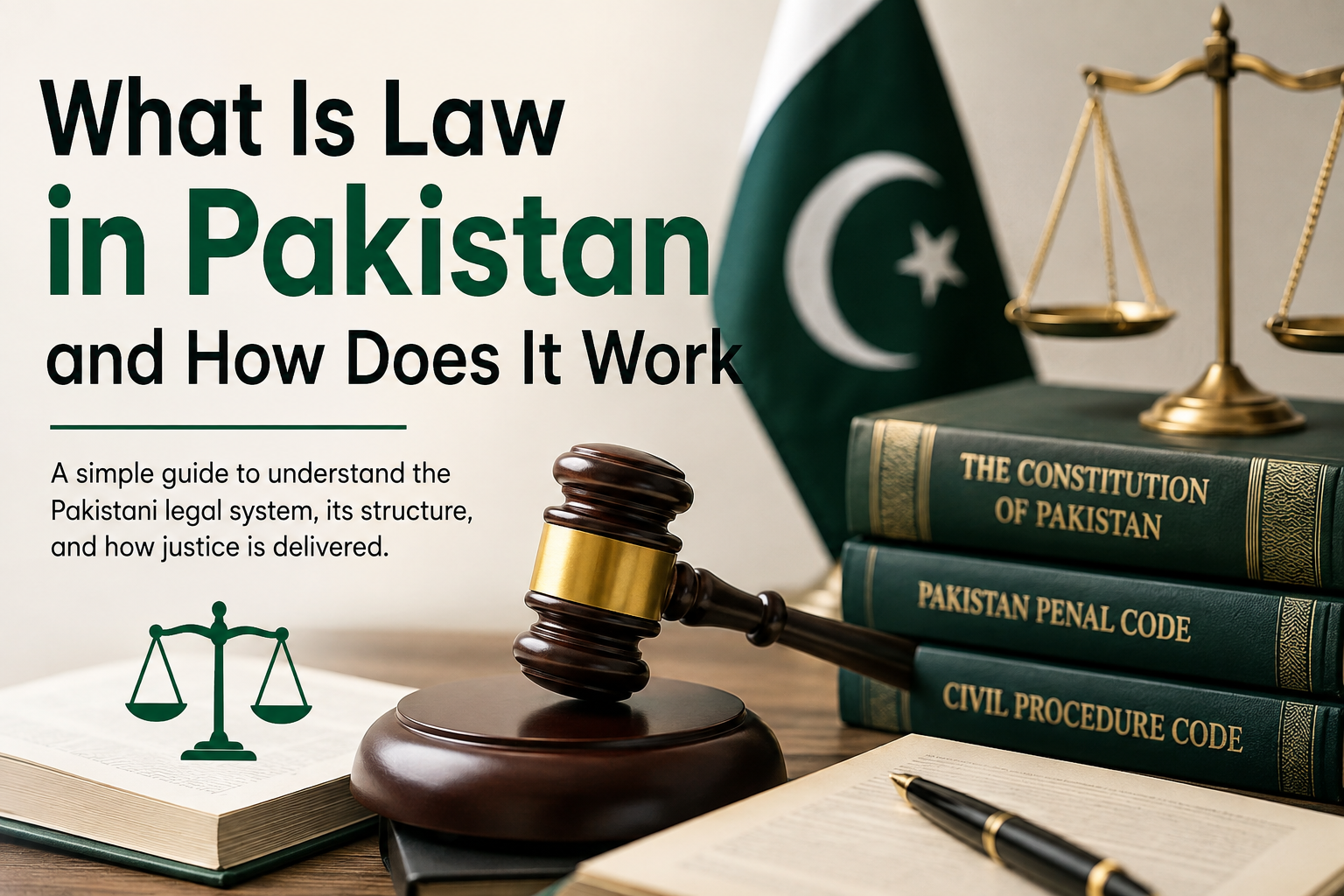
When we talk about law in Pakistan, we are talking about the rules and principles that guide how people, businesses, government institutions, and courts should operate. In my view, understanding the basic legal system is important for everyone because laws affect many parts of our daily lives, from property and family matters to employment, business, taxation, criminal offences, and personal rights.
Pakistan has a formal legal system based on the Constitution, legislation, judicial decisions, regulations, and other recognized sources of law. The official Pakistan Code provides access to federal legislation and is maintained by the Ministry of Law and Justice. It includes important laws such as the Pakistan Penal Code, Code of Civil Procedure, Code of Criminal Procedure, and many other federal laws.
In this article, I will explain what law means in Pakistan, where Pakistani laws come from, how laws are made, how courts work, and why understanding the law matters to ordinary citizens.
What Is Law in Pakistan?
Law in Pakistan can be understood as a system of legally enforceable rules that regulates society. These rules establish rights, responsibilities, procedures, offences, penalties, and methods for resolving disputes.
The Constitution of Pakistan is the fundamental legal document of the country. It establishes the framework of the state and provides the structure for important institutions, including Parliament, the executive, and the judiciary. The National Assembly currently provides an official version of the Constitution incorporating amendments through November 21, 2025.
For me, the easiest way to understand law is to think of it as a framework that tells us what we can do, what we cannot do, and what legal options are available when our rights or interests are affected.
The Constitution and the Legal System
The Constitution sits at the center of Pakistan’s legal framework. It establishes institutions of government and recognizes fundamental rights.
The Constitution also provides the foundation for the judiciary. Article 175 provides for the Supreme Court of Pakistan, a High Court for each province, and other courts that may be established by law.
This is important because courts do not simply operate independently of the legal framework. Their jurisdiction comes from the Constitution and laws.
The Constitution can also be amended through the constitutional process. This means that Pakistan’s constitutional framework can change over time when amendments are properly made.
Where Do Pakistani Laws Come From?
There is more than one source of law in Pakistan. Understanding these sources makes the legal system much easier to understand.
The Constitution
The Constitution provides the highest constitutional framework for the country. Other laws and government actions must operate within the constitutional structure.
Acts of Parliament
Parliament can make laws within its constitutional authority. The National Assembly describes itself as the country’s sovereign legislative body and explains that it makes laws for the Federation in areas assigned to it under the Constitution.
When Parliament passes legislation through the required constitutional process and it receives the necessary approval, it becomes an Act.
Provincial Legislation
Pakistan is a federal country, so provincial governments and legislatures also have important lawmaking responsibilities. Depending on the subject, a matter may fall within federal or provincial legislative authority.
This is one reason why a person should not assume that every legal issue is governed by exactly the same rules throughout Pakistan.
Ordinances and Regulations
The legal system also contains other forms of legislation and subordinate rules. Government departments and authorized institutions may make rules and regulations where legislation gives them the power to do so.
The Pakistan Code includes federal laws and provides access to primary and secondary legislation. It also states that newly enacted legislation is added after publication in the official Gazette when reasonably practicable.
Judicial Decisions
Courts also play an important role in explaining and applying the law. Decisions of higher courts can guide lower courts when similar legal questions arise.
The Supreme Court’s own description of Pakistan’s judicial system explains that the Supreme Court is the apex court and that its precedents are binding on other courts.
How Are Laws Made in Pakistan?
Many people wonder how a proposed law becomes an actual law. The process generally starts with a proposed Bill.
A Bill may be introduced and considered by the relevant legislative body. Members discuss the proposal, committees may examine it, and the legislative process provides opportunities for debate and changes.
Once the required parliamentary procedure is completed and the constitutional requirements are satisfied, the Bill can become an Act.
The National Assembly’s official information explains that Parliament uses debates, questions, committees, and other procedures as part of its legislative and oversight functions.
I think this process is important because laws can affect millions of people. Ideally, legislation should therefore be examined carefully before it becomes legally enforceable.
How Do Courts Work in Pakistan?
The courts are responsible for deciding legal disputes and applying the law to individual cases.
Pakistan’s judicial system has a hierarchical structure. At the top is the Supreme Court. High Courts operate at the provincial level, while subordinate courts deal with many civil and criminal matters at the district and local levels.
Different courts have different jurisdictions. This means that a person cannot simply take every type of legal dispute to any court.
For example, civil courts commonly deal with disputes involving matters such as property, contracts, money claims, and other civil rights. Criminal courts deal with allegations that a person has committed an offence under criminal law.
The exact procedure depends on the nature of the case and the applicable law.
Civil Law and Criminal Law
One of the easiest ways to understand Pakistani law is to distinguish between civil and criminal matters.
Civil Law
Civil law generally deals with disputes between individuals, businesses, organizations, or other parties.
A property disagreement, contract dispute, recovery claim, or certain family and commercial disputes may involve civil proceedings.
The purpose of a civil case is generally to resolve a legal dispute and provide an appropriate legal remedy.
Criminal Law
Criminal law deals with conduct that the state treats as an offence.
The Pakistan Penal Code is one of the major federal criminal laws listed by the Pakistan Code. The Code of Criminal Procedure provides important procedural rules concerning criminal proceedings.
Criminal cases can involve investigation, prosecution, evidence, hearings, and judicial determination.
It is important to remember that the exact legal process can vary according to the offence and the applicable legislation.
What Is the Role of a Lawyer?
A lawyer can help a person understand legal rights, procedures, documents, evidence, and available legal remedies.
In my opinion, professional legal advice becomes particularly important when a matter involves property, criminal allegations, family disputes, business contracts, taxation, employment, or significant financial consequences.
A lawyer does not replace the court. Instead, the lawyer represents or advises a client within the legal system.
Because Pakistani laws can be detailed and procedures can change, relying on a general internet article for a specific legal dispute may not be enough. A qualified lawyer should be consulted when a person’s legal rights or obligations are seriously involved.
Why Is Understanding Pakistani Law Important?
Many people only think about law when they have a problem. I believe it is much better to understand basic legal rights before a serious problem occurs.
For example, understanding contracts can help a person before signing an agreement. Knowing basic property law can encourage someone to verify documents before purchasing land. Understanding employment rules can help workers and employers recognize their responsibilities.
The same applies to online activities, businesses, family matters, taxation, and government services.
The official Pakistan Code is particularly useful because it provides a searchable collection of federal legislation. According to its official FAQ, users can search legislation in English and Urdu and can browse laws through different categories and indexes.
Law and Fundamental Rights
The Constitution provides important protections for citizens. Fundamental rights form an important part of Pakistan’s constitutional structure.
These rights are relevant because government authorities and other institutions operate within a constitutional framework.
The National Assembly also states that its oversight role includes ensuring that government functions remain within the parameters established by the Constitution and that fundamental rights are not violated.
However, understanding a constitutional right is different from successfully applying it to a particular legal situation. The facts of each case, applicable legislation, jurisdiction, evidence, and court procedure can all matter.
What Happens When Someone Breaks the Law?
When a person is suspected of committing an offence, the legal system provides procedures through which the allegation can be investigated and prosecuted.
The process can involve law enforcement agencies, prosecutors, lawyers, witnesses, evidence, and courts.
A court ultimately considers the relevant legal issues and evidence according to the applicable procedure.
This is why I think it is important to avoid deciding that someone is legally guilty simply because an allegation has been made. Criminal responsibility is determined through the legal process.
How Can Ordinary People Find Pakistani Laws?
One of the easiest starting points is the official Pakistan Code website. It is maintained by the Ministry of Law and Justice and provides access to federal legislation.
People can search for laws by name or subject. The website contains legislation in revised form and explains that amendments are incorporated into the relevant texts.
The National Assembly website is also useful for accessing constitutional and parliamentary information. Its current downloads section includes the Constitution of Pakistan as amended through November 21, 2025.
For a specific legal dispute, however, official sources and professional legal advice are generally more reliable than relying only on social media posts or general websites.
Final Thoughts
In my view, law in Pakistan is much easier to understand when we stop thinking about it as a collection of complicated legal words and start seeing it as a system that organizes society.
The Constitution provides the basic framework. Parliament and provincial legislatures create laws within their constitutional powers. Government institutions implement laws and regulations. Courts interpret and apply legal rules when disputes arise. Lawyers help people understand and navigate the system.
Pakistan’s legal system contains many different areas, including constitutional law, criminal law, civil law, family law, property law, commercial law, taxation, employment law, and other specialized fields.
The most important thing I would recommend to anyone learning about Pakistani law is to use reliable sources and check the current version of the relevant law. Laws can be amended, new legislation can be introduced, and court decisions can affect how legal provisions are interpreted.
For general education, learning the basics of the Pakistani legal system is a useful first step. For an actual legal problem, however, it is always better to consult a qualified legal professional who can consider the specific facts and current law.
Note: This article is provided for general educational and informational purposes only. It is not legal advice and should not be treated as a substitute for advice from a qualified lawyer in Pakistan.